
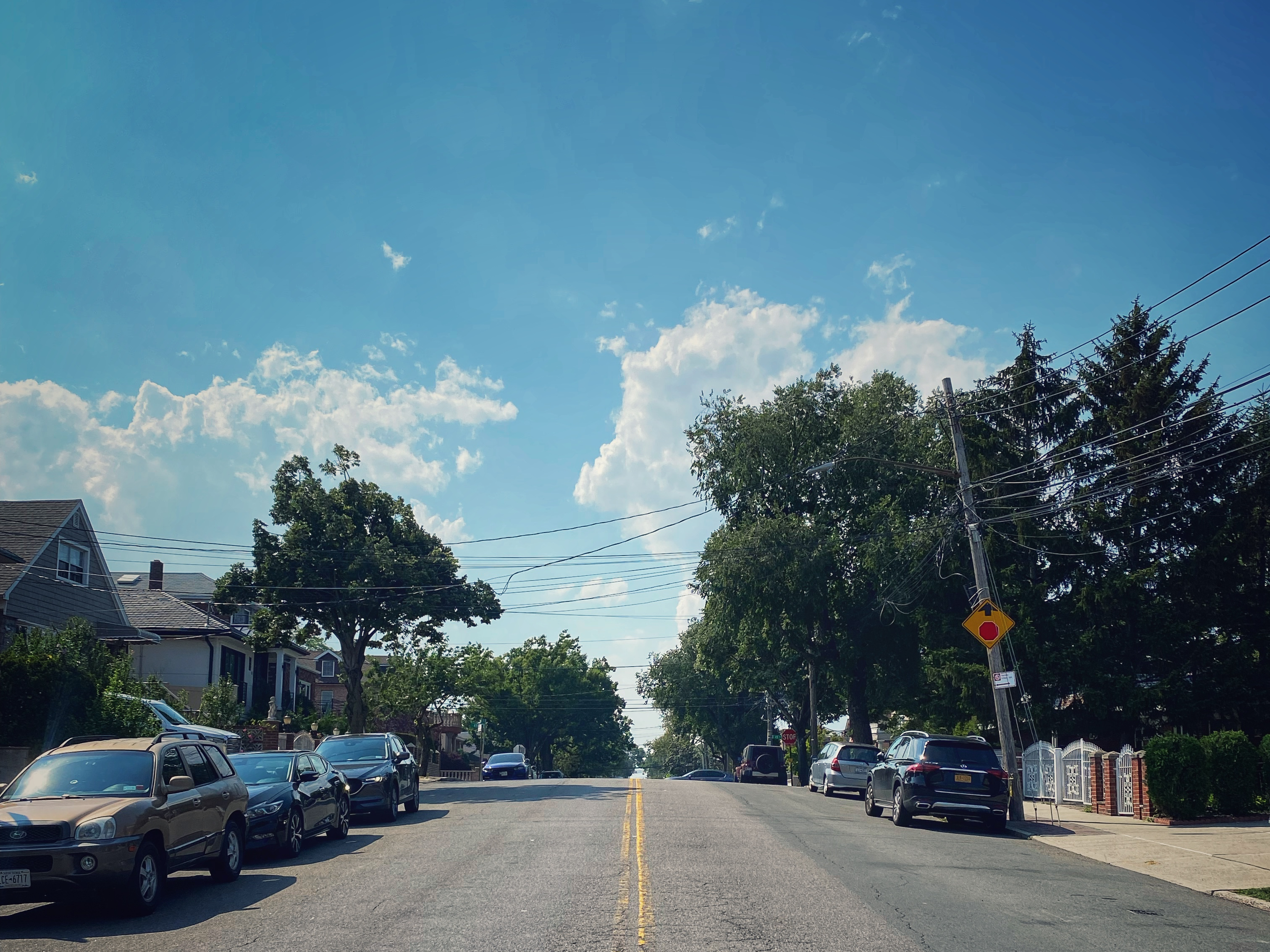
Passing through a residential neighborhood in Queens about a mile and a half from where I live there’s a long road, 21st Avenue, with a series of hills that I look forward to running on most days. The road’s total length is maybe a mile and a half, but feels like an adventure to train on because the hills evoke, somehow, rolling country terrain. It begins with a quick climb over one block, levels out at the first intersection, dips down and then climbs over the next four blocks until reaching its highest point, by a church (whose bells are a recording). Past the church the road gently descends for four more blocks, then it’s uphill again for eight, until it passes a high school. One more downhill for five blocks, past public housing, until it reaches the edge of Astoria Park, with a view of the East river and Randall’s Island just across the water’s currents. If you use your imagination the road is about as country as it gets running the city.
A run that stays on 21st Avenue the entire time is a decent one, but predictable. A more interesting run takes advantage of the various options the road offers for straying from it. I think of it as a starting point with a sense of possibility, an axis of most runs that connects to a variety of alternative, wandering, exploratory routes. At each of twenty or so intersections along the road’s length I can turn right or left. One way (West on a run’s outbound) leads to a main commercial street one block over, Ditmars, and beyond. (Sometimes far, far beyond, like Brooklyn.) The other way (East on outbound) leads downhill to a grittier 20th Avenue, where there’s auto body shops, a cross fit gym, and a power plant. Past 20th, just north of LaGuardia airport and Riker’s Island, hiding in plain sight among warehouses, is the Steinway & Sons piano factory.
Most days my warm up ends as I begin on 21st Avenue and soon turn left or right off of it with a vague sense of destination, deciding where I’m going as I go along. Runners are constrained by time (Do I have time for a short run or a longer run?) and energy (What am I up to doing?) but fueled by curiosity. Questions begin pre-run as I’m getting changed, choosing shoes, considering routes. Pass by the airport or go wide? A small or large loop? A slow pace or a fast one? Pumas or Adios Pros? But once I’m on the hills of 21st Avenue there’s no plan, just exuberance and a few decisions about where to turn, where to wander. As with making music or writing essays, now is the best time to try a new route, a new path through the borough of your mind. Change it up!
•
Runners know that the exploring they do on city streets or country trails is as much psychological as it is geographical. This is why running, like the urban amblings of the flâneur but with more speed and intensity, is a practice of psychogeography. In 1955 the French philosopher Guy Debord defined the term:
“Psychogeography could set for itself the study of the precise laws and specific effects of the geographical environment, whether consciously organized or not, on the emotions and behavior of individuals. The charmingly vague adjective psychogeographical can be applied to the findings arrived at by this type of investigation, to their influence on human feelings, and more generally to any situation or conduct that seems to reflect the same spirit of discovery.”
As psychogeographers, runners moving through an environment learn about both place and self. They learn about how place and daily variations of its weather stimulate the imagination, often by mysterious means. In his book Scarp, the writer and self-described “deep topographer” Nick Papadimitriou calls this stimulation proximity flight: “that’s what I call this using of environment to trigger mental journeys to another place and time in which the same stimuli can be found” (Scarp, p. 44).
How do these mental journeys, these running-induced proximity flights work? How is it, for example, that a street reminds you of somewhere else? Or that the scent of a few pine trees triggers a memory? How do other times inhabit your present?
Running addresses these questions—or at least stimulates an endorphin-fueled semblance of an answer—by immersing you in them. To run is to explore an environment: going there for the first time to experience it, to move through that alley or up that incline or around that path that you noticed before but never explored until today. As we explore, we tune into our body’s awareness of place and of itself—we become moving sensors. While running I’ve learned about technique too. For example, how to alter footstrike position from heel to midsole to toe and back again. It’s a slight shift of emphasis, as much perceptual as physical, felt but only in the subtlest of ways, an awareness you can only learn on the run. Running outside and in all weather is like improvising music: it’s a physical and mental super stimulus that triggers whole body responses to compensate for a continually changing terrain.
•
When I’m heading home I usually end up back on the hills of 21st Avenue. Since I’m coming from the other direction the hills look different and the final four blocks are a thrilling downhill. (If no cars are around I’ll run smack in the middle of the road and book it.) Somehow running always feels fresh, and maybe a reason for this is that an ideal run is characterized by continual change. The runner as psychogeographer knows this and chases that ideal, seeking novel routes, paces, and intensities, attuning to the road with his footsteps, witness to his thoughts untethering from anxious logics, and sensing linear moods becoming cyclical vibes. Running is a rhythm for setting free our attention as we explore right where we are.

 brettworks
Leave a comment