
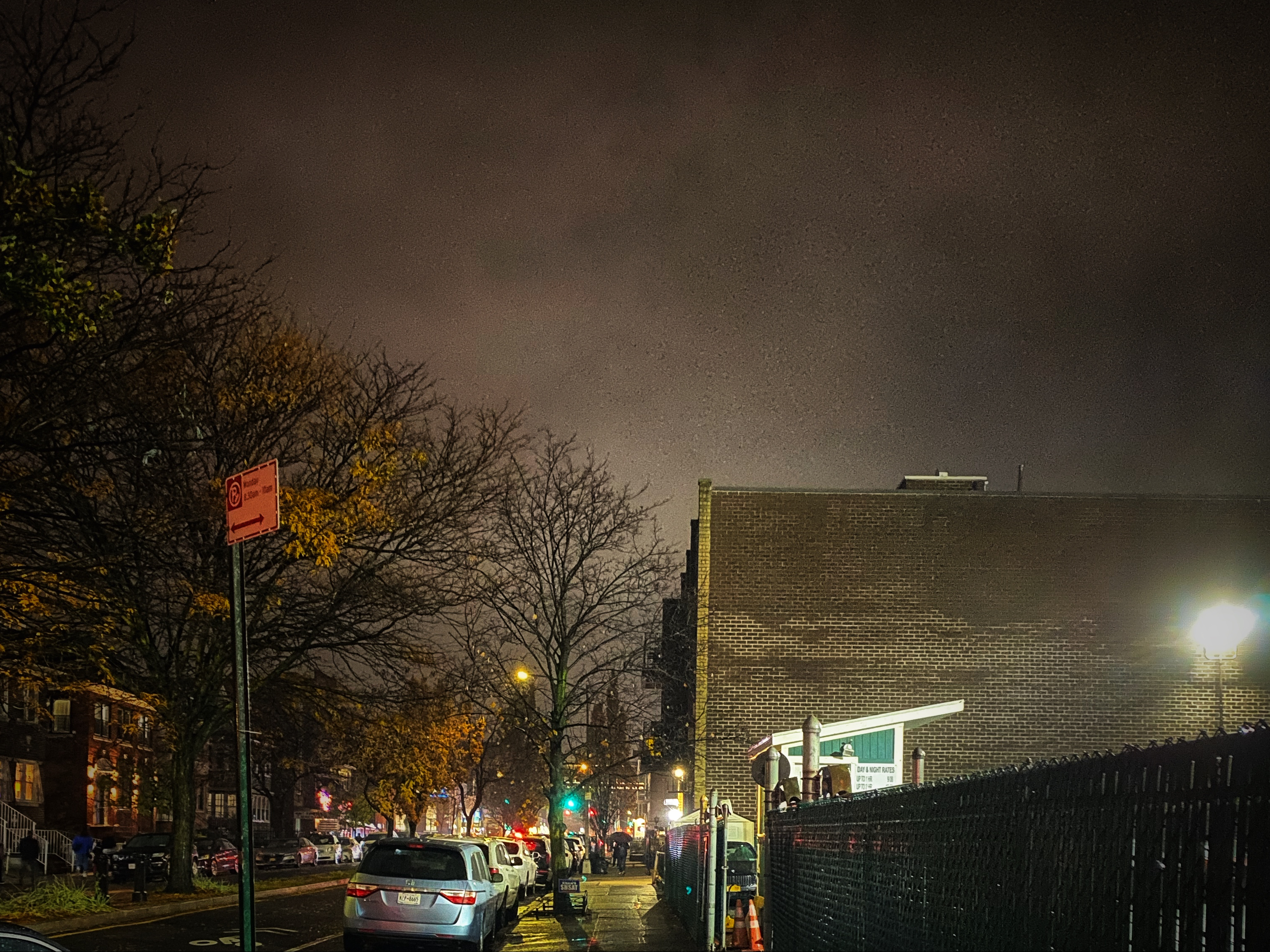
Our subway stop has been under repair for a few months, so going anywhere involves walking a half mile to the 74th street stop. The 12-minute walk isn’t scenic, but it is a good time to spend listening to music. In fact, walking—not running, or sitting—may be the best way to listen to music because the activity provides something physically easy, yet non-trivial to do while your attention floats elsewhere. Walking grounds you, and a walking listener has a slow- and ever-changing scene to accompany what’s in the headphones, as if the environment is asking the music to soundtrack the walk.
I use the walk to check out new music, revisit pieces saved on Brett’s Sound Picks, and also return to random classics to hear how they’re holding up. Finding new music involves quickly “spot listening” through an entire recording to see if anything jumps out, then focusing on that. Sometimes artists put their best tracks first, but often not. A good track can be anywhere and locating it a hit or miss/it depends on chance process. But the interesting question is what makes a track good, or even great? It grabs you from the outset with a way of doing things you’ve never heard before. It pulls off sound design, a chord progression, a mood, or a structure in way that is both not obvious yet feels inevitable. It does what it does exceedingly well. Or it brings you into a world, succeeding in having you suspend your disbelief for a while.
Arovane, “rotor” (2023). I first heard Arovane’s music around 2001, at Kim’s, a record store in the East Village staffed by unusually knowledgeable music nerds. This 2023 track shows off Arovane’s knack for beguiling timbres, but it also has a subtle pulsing insistence about it, an urgency and not just a sound designer’s prettiness.
Arvo Pärt, Sequentia (2014). Pärt always does so much–emotionally and structurally–with seemingly so little. In this 2014 piece, you hear a string quartet and contrabass, concert bass drum, tubular bells, glockenspiel, and triangle. The beauty here lies in how much Pärt conjures using few notes, and their by-product, space. Whenever I listen to Pärt I remember an interview in which he talked about the ethics of music and how different musics might affect us for better, or for worse.
Ravel, Pavane pour une infante défunte (1899)
Ravel imagined this piece for solo piano as a nostalgic evocation of a very slow processional dance (pavane) danced by young princess (infante) in a 16th- or 17th-century Spanish court. To modern ears though, “Pavane” sounds, well very modern–like an ahead of its time blueprint for film music’s tonal world. It sounds Romantic but with hints of the 20th-century’s dissonances and jazz harmonies still to come, many decades down the road. The beauty of this music is in the way it unfolds over a series of tableaus or episodes that are like self-contained snapshots of different scenes, each a variation on a single mood.
Autechre, Overand (1995). Before they dove deep into building AI-like Max/MSP patches to use as systems for generating music, Autechre deconstructed conventional electronic musical instruments to forge a kind of techno-adjacent sound. But this description doesn’t do justice to to the originality of their sonic alchemy. AE’s best music appears to have no direct stylistic precedents, and not only that, it isn’t beholden to any social scene, sound ideal, or indeed any familiar…anything. “Overand” is a beautiful and elegant piece of music that hides none of its parts and has a power that arises from extremes of the frequency spectrum in balance. Listen to the piercingly high tones hanging over the falling 4-note melody (evoking the Japanese Sakura scale…), pulsing pads, and deep bass notes. And notice the breakdown drum section (4:00) where quiet snare rolls and kick hits ratatat whisper over the bass. “Overand” shows the intersection of sound design and electronic orchestration, and the result is a unique music. If the track were transcribed for an acoustic ensemble performing it at Carnegie Hall, I would be right there in the front row.

 brettworks
Leave a comment