
[On the art of Agnes Martin] “They’re consistently sized, most of them six-foot squares of canvas, and as simple and gentle as any artwork ever made, yet with an inner strength. Each canvas is covered with repeating patterns in soft, pale colors; some are grids drawn with a ruler in pencil, others vertical or horizontal stripes of paint. The effect is quietly meditative; the paintings shimmer and waver even when you stand still in front of them, creating deep spaces out of flat images. Their simple construction becomes hazy and unstable, like a city skyline or mountain ridge seen from a distance. The landscape metaphors fit since Martin thought of her lines as horizons. The imperfect, handmade quality was important to her—she actually saw herself as an Abstract Expressionist rather than a
Minimalist.”
“There’s no one focal point but a kind of visual hum across the field that holds the stretches of emptiness and moments of presence in balanced tension.”
“Minimalism can often lead to a stultifying sameness as everything becomes as simple as possible—the elegant, ambient, blank style that I’ve described. It whitewashes both literally and metaphorically, at times privileging the Westernized, sanitized versions of external influences while deemphasizing their origins. Minimalism’s sources get rebranded as high-minded art made by solo geniuses instead of the products of a globalized culture, even if the artists themselves readily acknowledged their debts.”
“Minimalism is a communal invention and the blank slate that it offers an illusion, especially given its history. It is popular around the world, I think, because it reacts against a condition that is now everywhere: a state of social crisis mixed with a terminal dissatisfaction with the material culture around us that seems to have delivered us to this point, though the fault is our own. When I see the austere kitchens and bare shelves and
elegant cement walls, the dim vague colors and the skeletal furniture, the monochrome devices, the white t-shirts, the empty walls, the wide-open windows looking out onto nothing in particular—when I see minimalism as a meme on Instagram, as a self-help book commandment, and as an encouragement to get rid of as much as possible in the name of imminently buying more—I see both an anxiety of nothingness and a desire to capitulate to it, like the French phrase for the subconscious flash of desire to jump off a ledge, l’appel du vide, the call of the void.”
“The rock garden [Ryōan-ji] is both less and more profound than it seems. It does not offer a solution to the chaos of the world via cleanliness and control, nor is it the end point of some non-Western cultural track. Instead, it’s a tool for awareness, a destabilizing provocation that everything is not as it seems, that what you see is not always what you get. It is minimalism as a continuous challenge.”
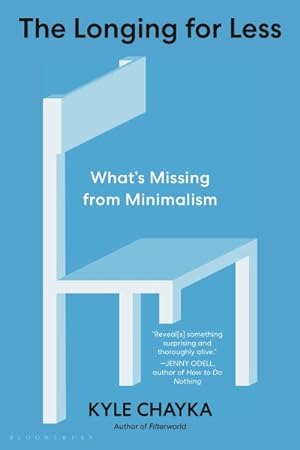
– Kyle Chayka, The Longing for Less: What’s Missing from Minimalism (2020)

 brettworks
Leave a comment