
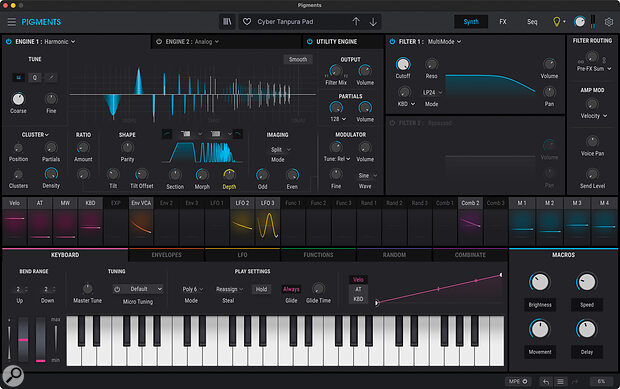
When we work with a virtual instrument such as a synthesizer or sampler, our attention tends to be on the sound at hand that we crafted or discovered. But in music production, a sound at hand is always more than one sound—its identity is not fixed but polyphonic—because variations of it are always close by.
Take a moment to look at the instrument’s numerous onscreen controls. Any software synthesizer, for example, has dozens of parameters, each of which can be controlled manually with a mouse or by drawing automation. Playing with parameters is the practice of making variations on your sound at hand by adjusting controls on the instrument that’s producing the sound. Begin simply: change the sound’s ADSR envelope to turn a sharp and short sound into a slow attack, long release one. Or open up a filter to reveal a sound’s details. Then go deeper: find the effects on the sound (if any) and change them up, or make the modulation routings more extreme or subtle. Capture your parameter play as you go, in multiple passes, by recording the automation changes over the timeline of the music. In sum, know that every virtual instrument’s GUI is a playground of often-ignored optionality. So before adding a new and unrelated sound to a track, play with the parameters of what you already have to discover an organically connected sound world.

 brettworks
Leave a comment