
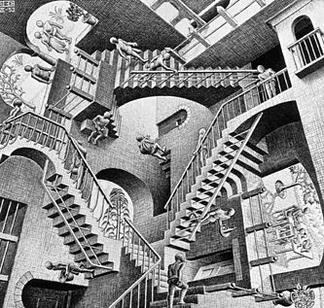
M.C. Escher, “Relativity” (1953)
Stereolab, “Crest” (1993). I first heard this song—and learned about Stereolab—during a musicology graduate seminar over twenty years ago. Another student had chosen the track as way to talk about a topic in musical time which I don’t recall, but the music mesmerized me and I’ve never forgotten it. Years later I played it for a non-musician friend who said it created an instant earworm. Play that song again! he would say excitedly, long before we had music streaming.
Stereolab is an Anglo-French avant-rock band whose sound, on this track at least, shows the influence of krautrock and its motorik beat style of steady drumming. “Crest” is a minor gem of rock minimalism and perhaps the most 4/4, un-funky, and unsyncopated music you’ll ever hear. Over the motorik beat, the relentless anchor of the song is the bass part climbing up an E Lydian scale (e, f-sharp, g-sharp, a-sharp, b, c-sharp, d-sharp) over and over, as if on an M.C. Escher-designed Stairmaster with no off button. Meanwhile the guitar alternates between distorted E and F-sharp major chords so that every third note of the moving bass aligns with an E chord. My favorite moment of the chord progression is when the final d-sharp of the bass’s ascent forms an E-major 7th chord with delicious dissonance because the bass is on the seventh degree of the scale, abutting the guitar’s tonic E. And like an Escher staircase, the bass forever ascends: eventually (1:30) it moves into a higher octave, then even higher (1:59), relinquishing its bass duties until dropping two octaves down again with oomph. The song’s vocals (mixed very low) are in the repetition game too, intoning three phrases on loop:
“If there’s been a way to build it/
there’ll be a way to destroy it/
Things are not all that out of control…”
In sum, “Crest” is noisily low-fi and intense and repetitive but also disciplined and not at all out of control. It’s a study in simply building and building with an intensity that’s unignorable. For me, “Crest” shows (1) how much composers can do with very few musical materials, (2) how every song with originality is really a one-off, and (3) how expressive possibilities open with the right kind of repetition.

 brettworks
Leave a comment