
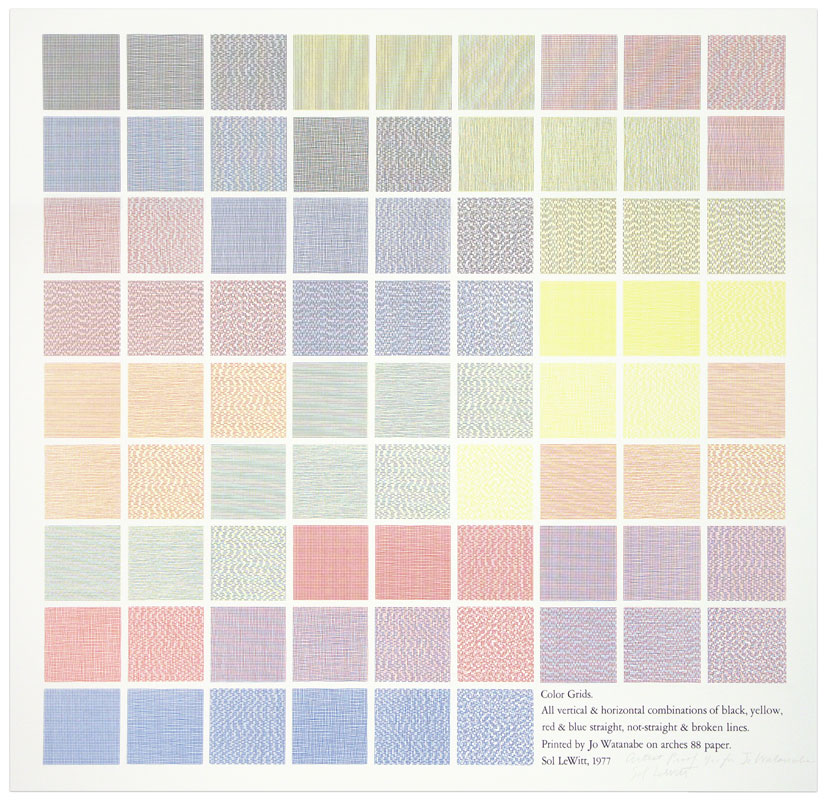
Sol LeWitt, “Color Grids” (1980)
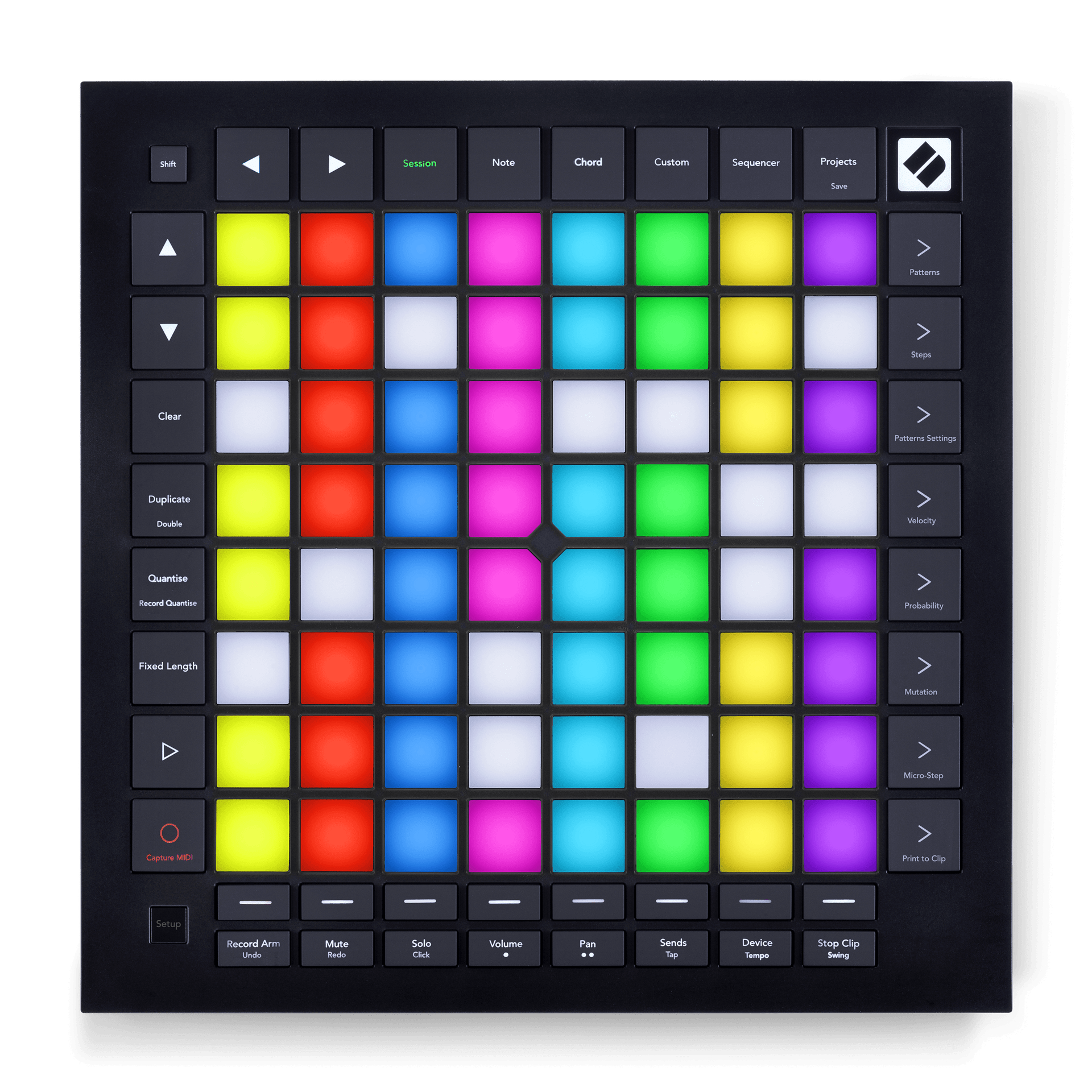
Novation Launchpad Pro (2024)
The 64-pad matrix grid MIDI controller is contemporary electronic music’s preeminent symbol. The grid represents square 4/4 time, quantized notes, auto-tuned pitch, 4-bar drum loops, and the triggered clips method of recombinant/modular composing. For a hundred years, grid forms were an emblem of modernist visual art, from Piet Mondrian’s “Composition with Grid #1” (1918) to Jasper Johns’ “Grey Numbers” (1958) to Agnes Martin’s “Untitled” (1965) to Sol LeWitt’s “Color Grids” (1980). As Rosalind Kraus explains in her 1979 essay Grids, the grid as aesthetic form is “flattened, geometricized, ordered, it is antinatural, antimimetic, antireal. It is what art looks like when it turns its back on nature” (Kraus, 50). The grid is “a mode of repetition” whose modernism represents “the antidevelopmental, the anti narrative, the antihistorical” (61, 64). From the art world grids entered music, inspiring minimalist composers who substituted impersonal geometric forms for classical music’s romantic complexities and a bit later, electronic musicians and DJs who tapped the power of electronically-generated beats. But today, as grid structures, grid devices, and grid thinking are omnipresent it’s all too easy to let them call our creative shots. Thus, musicians are evolving strategies for preserving the humanity in their work, finding ways to resist grid musical thinking and going off grid to discover ghosts in its machines, spirits in its circuitries, glitches in its systems. We mute the click, loosen the groove, bend the pitches, blur the texture, mess with the parameters, and give the music space to breathe. In sum, music isn’t a fixed grid, it isn’t a square problem in need of a square solution. Music is round and in-between, perpetually undefined–a fluid, imperfect improvisation in a state of becoming.

 brettworks
Leave a comment