
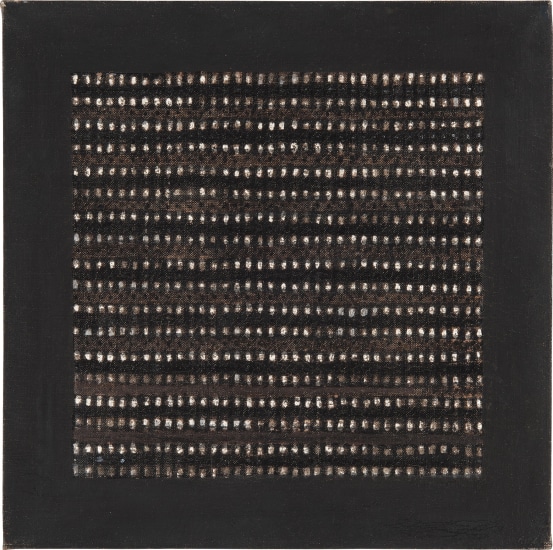
Agnes Martin, “Untitled” (1961)
Ambitious ideas imagine grand designs, but we achieve them through building small structures: one sentence then another, connected, a few considered sounds working in concert, counterpointed. Small structures is the principle of finding the most minimalist expression of a music’s idea, doing the least to achieve a maximum effect. A minimalist expression applies on several levels of scale, from the timbre of a sound to the trajectory of its part over time to a track’s arrangement. For example, you might be using a sound that’s cluttered with effects and so fails to do one thing well. Mute the effects to pare down the timbre, make it smaller, and reveal the essence of its expression. Or if you’ve recorded a part that’s too busy, that suffers from excessive variation instead of benefitting from consistency, simplify the part and make it more sparse. If the arrangement travels to many destinations instead of staying in place, you don’t need B and C and D sections, just a way to keep the A section compelling. Turn the linear timeline journey into a helix-shaped one that cycles deeper into the track’s materials instead of scatter plotting them further afield. When you mute effects, simplify parts, and fold the arrangement upon itself the music intensifies. With nowhere to hide now it sings.
By helping you find a track’s minimalist expression, the small structures principle is a way of building vast sonic panoramas out of a few musical gestures. Small structures are accessible to work with, easily scaled up, and a superabundant source of musical ideas that reduce the producer’s uncertainty about how to unfold the music. In sum, use small structures to keep a workflow from getting ahead of itself and instead focus on how far the music’s idea might be taken.

 brettworks
Leave a comment