
“Our eyes also appear to seek out patterns with a mid-level of fractal complexity .22 Why is this significant? Because evidence suggests that when we view silhouette outlines of natural scenes with this fractal dimension, it triggers greater levels of calming and attention restoration than when we look at the outline shape of other landscape types” (32).
“The number of times you have a repeating pattern within a larger pattern, or in other words its visual complexity, is called its fractal dimension. This is a ratio providing a statistical measure of the visual complexity (D-value) that has values ranging between 1 and 2. The greater the number of repeating patterns, the closer the D-value to 2. For example, a straight line has a D-value of 1, whereas a line with a multiple repeating pattern of wobbles in it recurring at finer and finer scales will be closer to 2.23. Fractals are found in many features of everyday life: in art, architecture and importantly in natural scenes” (33).
“When subjects viewed the [nature] image with a fractal dimension of 1.3 their brain wave activity showed heightened alpha and beta frequencies and reduced delta frequencies, indicating that the participants became more relaxed, with increased focus and attention, and less sleepy” (36).
“Within one minute of hearing the birdsong and the ocean sounds, the participants became physiologically calmer. The longer they listened, the greater the reduction in markers of stress, at least for the full five minutes of the experiment. Hearing street and traffic sounds, meanwhile, increased levels of physiological stress. This suggests that the longer we listen, the more pronounced the effects, good and bad (though the effects over longer time periods of hours, or cumulative effects over months and years, have yet to be tested” ( 126).
“Intriguingly, water sounds had the largest effect in terms of improving our mood and cognitive performance, whereas bird sounds had the largest effect in reduction of physiological symptoms of stress and annoyance (blood pressure, pain reduction and heart rate). What also emerged was the fact that the complexity of natural sound also seems to be an important factor, with more complex natural sounds having significantly improved health and decreased levels of stress and annoyance, compared to fewer or no sounds” (133).
“The fastest recovery from stress (as recorded in a number of physiological markers such as heart-rate variability, respiration rate and so on) occurred in those that heard the sounds of nature. In fact, those that just saw forest environments with no sound mentioned that they had experienced fear, expecting something threatening or dangerous to appear. Silent nature can be spooky” (134).
“We need to allow nature to sing to us” (140).
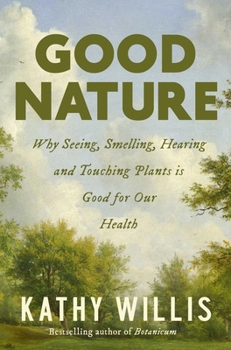
Kathy Willis, Good Nature (2024)

 brettworks
Leave a comment