
“intuitive knowledge exists, silent wisdom exists, instinctive insight exists, and I believe this unarticulated understanding of the world comprises a much larger part of our self than we usually imagine” (42).
“No art is free of morals, for the simple reason that all art entails a set of assessments of reality, and they are always social in nature, since no such thing as non-social art has ever existed, but–and this is important–art is moral first and foremost through form, since it is form which establishes a relation between the viewer and the viewed” (48).
“Writing cannot merely reconstruct a moment, it must itself be a moment, only then is it in touch with the world, not as depiction but as action. In other words, the distance between thought and emotion and language must be as small as possible. Only then can it come alive. It must not exist beforehand but come into being in the moment it is expressed. If that happens, it will also come into being in the moment we see it or read it, and it is this coming into being which justifies a word like ‘alive’ used about art and literature, which in themselves are merely dead colors on a dead canvas or dead letters on a dead book page. Knowledge is therefore not an advantage for an artist, because knowledge exists beforehand. Experience, intuitive, bodily experience, on the other hand, is crucial” (87).
“Quality lies in what is specific to the medium” (94).
“There are no rules in art, only conventions, and this makes judgements about quality so complicated, for criteria of quality also change of course and are based on conventions that are as difficult to see and identify as the tone of the times or the dominant pictorial language; as with these, arbitrary opinion comes to seem something natural and indisputable, at least in its broad outlines” (98).
“for what matters is that the painting is alive. It has a resonance, it oscillates, it is almost like music. This resonance is what the emotions latch on to and what lifts them, as music can lift one’s emotions” (116).
“That style is a way of controlling information” (145).
“Could it be painting as a kind of cosmological practice? Tending to the world? You’re out there looking, you have the talent for it, you have the required sensitivity, and you deal only with your own perception in a simple, de-ideologised, almost postmodern or post-religious way. I don’t really know, it’s easy to invest too much in these concepts, but perhaps they do after all have something to say about this. A form of cosmology or caretaking. [Munch] tends to his immediate world. And he practises painting as only he knows how” (161).
“As a writer, in the actual moment of writing, an absolutely necessary precondition is to be able to disregard what other people might think, and to be entirely alone with yourself, your thoughts and what eventually manifests itself on the page” (174).
“Art lives by transgressing boundaries, by going beyond what has been collectively decided, beyond what everyone has agreed to see and think” (176).
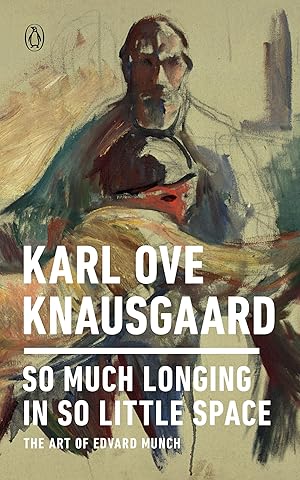
Karl Ove Knausgaard, So Much Longing in So Little Space:
The Art of Edvard Munch (2019)

 brettworks
Leave a comment