
“The craftsman’s habitual deference is not toward the New, but toward the objective standards of his craft. However narrow in its application, this is a rare appearance in contemporary life—a disinterested, articulable, and publicly affirmable idea of the good. Such a strong ontology is somewhat at odds with the cutting-edge institutions of the new capitalism, and with the educational regime that aims to supply those institutions with suitable workers—pliable generalists unfettered by any single set of skills” (19).
“Craftsmanship means dwelling on a task for a long time and going deeply into it, because you want to get it right” (20).
“Skilled manual labor entails a systematic encounter with the material world, precisely the kind of encounter that gives rise to natural science. From its earliest practice, craft knowledge has entailed knowledge of the ‘ways’ of one’s materials—that is, knowledge of their nature, acquired through disciplined perception” (21).
“We are getting more stupid with every passing year—which is to say, the degradation of work is ultimately a cognitive matter, rooted in the separation of thinking from doing” (38).
“Trafficking in abstractions is not the same as thinking” (44).
“Creativity is a by-product of mastery of the sort that is cultivated through long practice” (51).
“My work is a progressive revelation of something which exists independently of me. Attention is rewarded by a knowledge of reality” (65).
“It is these intrinsic goods of the work that make me want to do it well” (137).
“The current educational regime is based on a certain view about what kind of knowledge is important: ‘knowing that,’ as opposed to ‘knowing how.’ This corresponds roughly to universal knowledge versus the kind that comes from individual experience“ (161).
“The things we know best are the ones we contend with in some realm of regular practice” (163).
“If thinking is bound up with action, then the task of getting an adequate grasp on the world, intellectually, depends on our doing stuff in it” (164).
“Intuitive judgments of complex systems, especially those made by experts, such as an experienced firefighter, are sometimes richer than can be captured by any set of algorithms” (168).
“The experienced mind can get good at integrating an extraordinarily large number of variables and detecting a coherent pattern. It is the pattern that is attended to, not the individual variables” (168).
“The fact that a firefighter’s knowledge is tacit rather than explicit, and therefore not capable of articulation, means that he is not able to give an account of himself to the larger society” (171).
“We view human beings as inferior versions of computers” (179).
“An important feature of those practices that entail skilled and active engagement: one’s attention is focused on standards intrinsic to the practice, rather than external goods that may be won through the practice, typically money or recognition” (180).
“Those who belong to a certain order of society—people who make big decisions that affect all of us—don’t seem to have much sense of their own fallibility. Being unacquainted with failure, the kind that can’t be interpreted away, may have something to do with the lack of caution that business and political leaders often display in the actions they undertake on behalf of other people” (203).
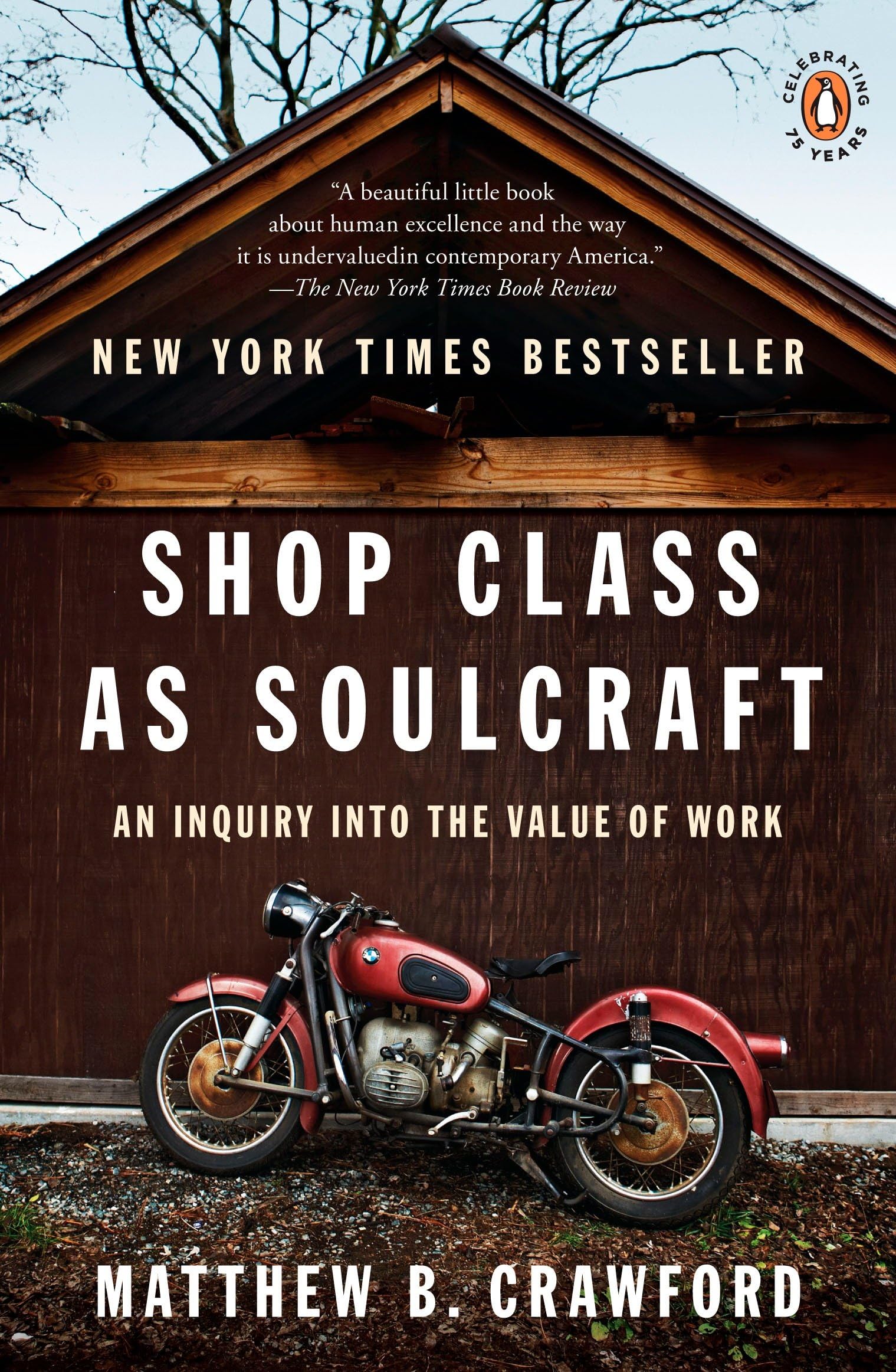
Matthew B. Crawford, Shop Class as Soulcraft

 brettworks
Leave a comment