
“Where there is no gift there is no art” (13).
“Usually, in fact, the artist does not find himself engaged or exhilarated by the work, nor does it seem authentic, until this gratuitous element has appeared, so that along with any true creation comes the uncanny sense that ‘I,’ the artist, did not make the work” (13).
“And if the fruits of a gift are gifts themselves, how is the artist to nourish himself, spiritually as well as materially, in an age whose values are market values and whose commerce consists almost exclusively in the purchase and sale of commodities?” (15).
“The desire to consume is a kind of lust. We long to have the world flow through us like air or food. We are thirsty and hungry for something that can only be carried inside bodies. But consumer goods merely bait this lust, they do not satisfy it. The consumer of commodities is invited to a meal without passion, a consumption that leads to neither satiation nor fire. He is a stranger seduced into feeding on the drippings of someone else’s capital without benefit of its inner nourishment, and he is hungry at the end of the meal, depressed and weary as we all feel when lust has dragged us from the house and led us to nothing” (31).
“The gifted artist contains the vitality of his gift within the work, and thereby makes it available to others” (53).
“An essential portion of any artist’s labor is not creation so much as invocation. Part of the work cannot be made, it must be received; and we cannot have this gift except, perhaps, by supplication, by courting, by creating within ourselves that ‘begging bowl’ to which the gift is drawn” (214).
“You really have to make a resolution just to write for yourself, in the sense of not writing to impress yourself, but just writing what your self is saying” (217).
“To accept the fruits of these things as gifts is to acknowledge that we are not their owners or masters, that we are, if anything, their servants, their ministers” (220).
“Gifts are the agents of that organic cohesion we perceive as liveliness” (224).
“This is one of the things we mean to say, it seems to me, when we speak of a person of strong imagination as being ‘gifted.’ In Biographia Literaria, Coleridge describes the imagination as ‘essentially vital’ and takes as its hallmark its ability ‘to shape into one,’ an ability he named ‘the esemplastic power.’ The imagination has the power to assemble the elements of our experience into coherent, lively wholes: it has a gift” (224).
“An artist who wishes to exercise the esemplastic power of the imagination must submit himself to what I shall be calling a ‘gifted state,’ one in which he is able to discern the connections inherent in his materials and give the increase, bring the work to life. Like the shoemaker at the end of ‘The Shoemaker and the Elves,’ the artist who succeeds in this endeavor has realized his gift. He has made it real, made it a thing: its spirit is embodied in the work” (224).
“To count, measure, reckon value, or seek the cause of a thing is to step outside the circle, to cease being ‘all of a piece’ with the flow of gifts and become, instead, one part of the whole reflecting upon another part. We participate in the esemplastic power of a gift by way of a particular kind of unconsciousness, then: unanalytic, undialectical consciousness” (226).
“The true commerce of art is a gift exchange, and where that commerce can proceed on its own terms we shall be heirs to the fruits of gift exchange: in this case, to a creative spirit whose fertility is not exhausted in use, to the sense of plenitude which is the mark of all erotic exchange, to a storehouse of works that can serve as agents of transformation, and to a sense of an inhabitable world—an awareness, that is, of our solidarity with whatever we take to be the source of our gifts, be it the community or the race, nature, or the gods. But none of these fruits will come to us where we have converted our arts to pure commercial enterprises” (235).
“The artist who hopes to market work that is the realization of his gifts cannot begin with the market. He must create for himself that gift-sphere in which the work is made, and only when he knows the work to be the faithful realization of his gift should he turn to see if it has currency in that other economy. Sometimes it does, sometimes it doesn’t” (397).
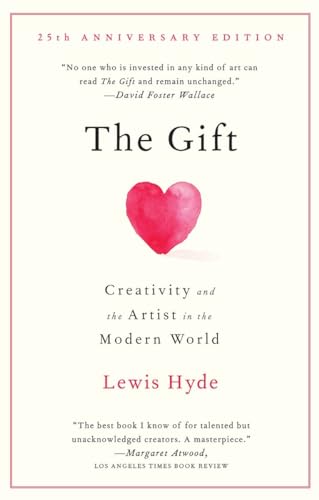
– Lewis Hyde, The Gift: Creativity and the Artist in the Modern World (1983/2007)

 brettworks
Leave a comment