
“Memory and forgetting: these are the faculties of mind by which we are aware of time, and time is a mystery. In addition, a long tradition holds that the imagination is best conceived as operating with a mixture of memory and forgetting. Creation—things coming into being that never were before—that too is a mystery. Writers like me who work very slowly are well advised to settle on topics such as these, topics whose fascination may never be exhausted. Such authors do not simply tell us what they know; they invite us to join them in fronting the necessary limits of our knowing” (6).
“Question: How does one create ‘a new thought’ for any object? Answer: Move it around” (260).
“DISTANCE. The painter Brice Marden sometimes draws with a long stick or branch dipped in ink, distancing himself from the work and deliberately interfering with his control of the stroke. Says Marden, ‘The works start out with observation and then automatic reaction, and then I back off, so there’s a layering of different ways of drawing. … It’s the opposite of knowing yourself through analysis. It’s more like knowing yourself by forgetting yourself, learning not to be so involved with yourself.’ How to forget yourself: use a long stick” (262).
“How did Agnes Martin begin a painting? She would sit and wait for something to come to mind. Once, early in her career, she was thinking of ‘the innocence of trees’ and ‘a grid came into [her] mind. It looked like innocence.’ From then on, her paintings were all variations on the grid” (269).
“I gave up facts entirely in order to have an empty mind for inspiration to come into.… You have to practice quiet, empty mind. I gave up the intellect entirely. I had a hard time giving up evolution and the atomic theory but I managed it. … And I never have any ideas myself. I’m very careful not to have ideas” [Agnes Martin] (270).
“by way of counterpoint” (324).
“Had Darwin been a student of Zen, then during his time on the cushion he would have had to return to the breath and forget about his brilliant idea. He might have had to say, as Agnes Martin did, ‘I had a hard time giving up evolution,’ but such is the practice of radical nonaction” (336).
“…book’s episodic form, but if there is one, it most likely lies in the way that juxtaposition encourages not just free association but free forgetting. Jumping from one thing to another, the entries decline to declare a train of thought” (339).
“Interpretation too readily declared dims the lights of things; holding off allows the elements to glow” (339).
“The spaces between entries foreground what happens with any book we read: we retain some things as we go along, while others drop away until, finally, out of the keepers and the discards, we extract the unique book of our own engagement” (339).
“The episodic form acknowledges the collaged afterlife of anything we read—or of any life, for that matter, for we too are discontinuous creatures, scattered in time, the meaning of our existence something we can only imagine” (339).
“a bird sees birds’ traces” (340).
“Not all actions are the same. Returning to the breath, the action of nonaction, is distinct and gives rise to a distinct kind of self—the true self” (340).
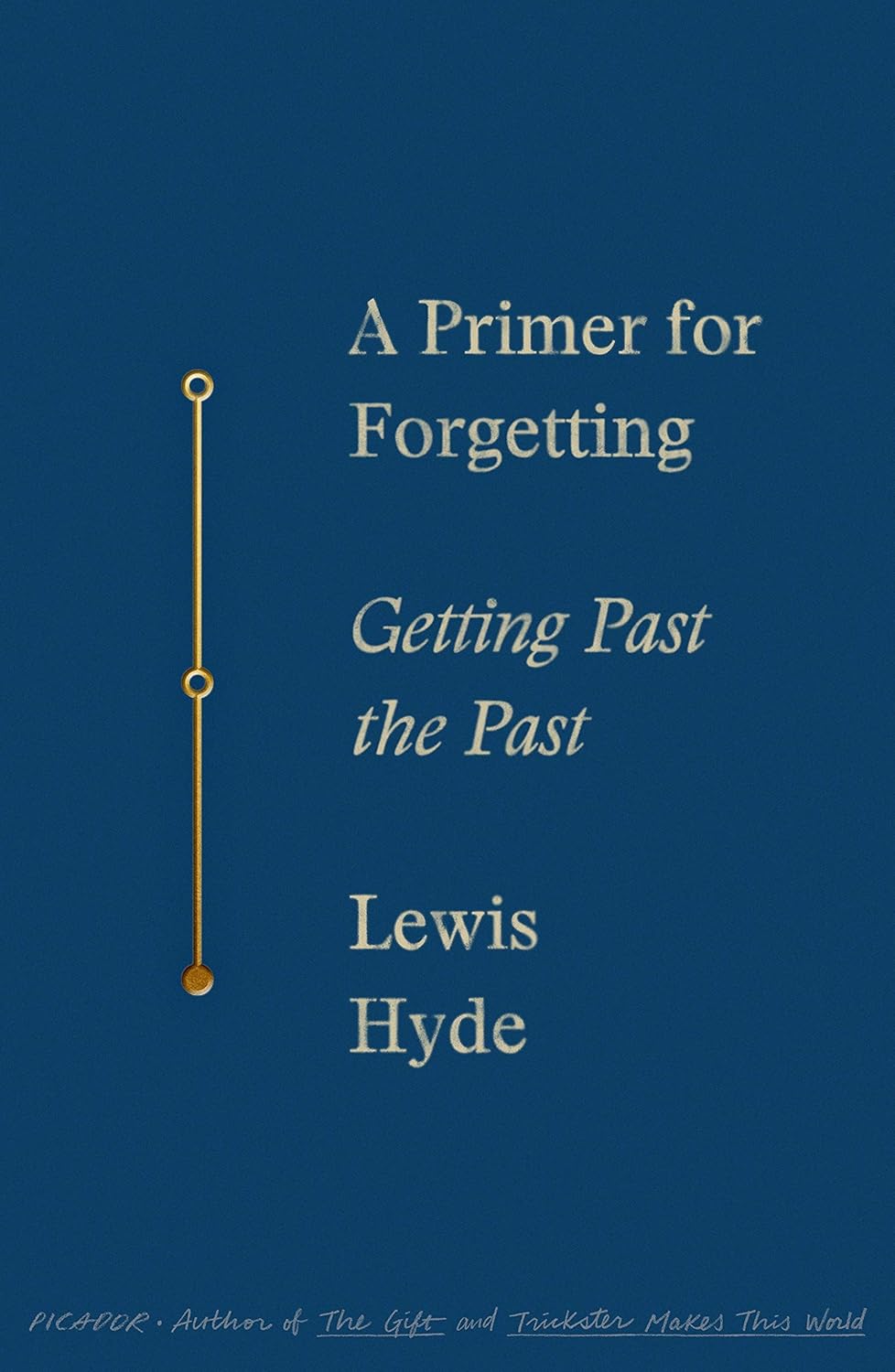
Lewis Hyde, A Primer for Forgetting: Getting Past the Past (2020)

 brettworks
Leave a comment