
“…in reality the future is unlike the past, the unseen very different from the seen. Science often predicts – and brings about – phenomena spectacularly different from anything that has been experienced before” (6).
“Discovering a new explanation is inherently an act of creativity” (7).
“We never know any data before interpreting it through theories. All observations are, as Popper put it, theory-laden, and hence fallible, as all our theories are” (10).
“So we perceive nothing as what it really is. It is all theoretical interpretation: conjecture” (10).
“‘There is nothing more deceptive than an obvious fact’” [Sherlock Holmes] (10)
“I mean, literally, by what process do ever truer and more detailed explanations about the world come to be represented physically in our brains?” (11).
“For most of human history, we did not know how to do any of this. People were not designing microchips or medications or even the wheel. For thousands of generations, our ancestors looked up at the night sky and wondered what stars are – what they are made of, what makes them shine, what their relationship is with each other and with us – which was exactly the right thing to wonder about. And they were using eyes and brains anatomically indistinguishable from those of modern astronomers. But they discovered nothing about it. Much the same was true in every other field of knowledge. It was not for lack of trying, nor for lack of thinking. People observed the world. They tried to understand it – but almost entirely in vain. Occasionally they recognized simple patterns in the appearances. But when they tried to find out what was really there behind those appearances, they failed almost completely” (11).
“…conflicting ideas in a broader sense are the occasion for all rational thought and inquiry. For example, if we are simply curious about something, it means that we believe that our existing ideas do not adequately capture or explain it. So, we have some criterion that our best existing explanation fails to meet. The criterion and the existing explanation are conflicting ideas. I shall call a situation in which we experience conflicting ideas a problem” (17).
“A new conjuring trick is never totally unrelated to existing tricks. Like a new scientific theory, it is formed by creatively modifying, rearranging and combining the ideas from existing tricks” (18).
“By adopting easily variable explanations, the gambler and prophet are ensuring that they will be able to continue fooling themselves no matter what happens” (22).
“Creativity The capacity to create new explanations” (30).
“The real source of our theories is conjecture, and the real source of our knowledge is conjecture alternating with criticism” (32).
“We create theories by rearranging, combining, altering and adding to existing ideas with the intention of improving upon them. The role of experiment and observation is to choose between existing theories, not to be the source of new ones” (32).
“Feeling insignificant because the universe is large has exactly the same logic as feeling inadequate for not being a cow. Or a herd of cows. The universe is not there to overwhelm us; it is our home, and our resource. The bigger the better” (35).
“A repetitive experiment is not repetitive if one is thinking about the ideas that it is testing and the reality that it is investigating” (36).
“observation is theory-laden” (41).
“The growth of knowledge consists of correcting misconceptions in our theories” (41).
“…there will always be problems in the benign sense of the word: errors, gaps, inconsistencies and inadequacies in our knowledge that we wish to solve – including, not least, moral knowledge: knowledge about what to want, what to strive for” (63).
“The field of artificial (general) intelligence has made no progress because there is an unsolved philosophical problem at its heart: we do not understand how creativity works” (163).
“Composers like Ludwig van Beethoven agonized through change after change, apparently seeking something that they knew was there to be created, apparently meeting a standard that could be met only after much creative effort and much failure. Scientists often do the same. In both science and art there are the exceptional creators like Mozart or the mathematician Srinivasa Ramanujan, who reputedly made brilliant contributions without any such effort. But from what we know of knowledge creation we have to conclude that in such cases the effort, and the mistakes, did happen, invisibly, inside their brains” (355).
“…you are an artist, and halfway through creating a work of art you see something in it that you want to bring out, then you are being attracted by a beauty that you have not yet experienced. You are being attracted by the idea of a piece of art before you have created it” (358).
“…idea of creativity is still rather confused by various misconceptions. Empiricism miscasts science as an automatic, non-creative process. And art, though acknowledged as ‘creative’, has often been seen as the antithesis of science, and hence irrational, random, inexplicable – and hence unjudgeable, and nonobjective. But if beauty is objective, then a new work of art, like a newly discovered law of nature or mathematical theorem, adds something irreducibly new to the world” (358)
“Art can be used for many purposes. But artistic values are not subordinate to, or derived from, anything else” (366).
“Parrots copy distinctive sounds; apes copy purposeful movements of a certain limited class. But humans do not especially copy any behaviour. They use conjecture, criticism and experiment to create good explanations of the meaning of things – other people’s behaviour, their own, and that of the world in general” (410).
“That is what creativity does. And if we end up behaving like other people, it is because we have rediscovered the same idea” (410).
“On the face of it, creativity cannot have been useful during the evolution of humans, because knowledge was growing much too slowly for the more creative individuals to have had any selective advantage. This is a puzzle. A second puzzle is: how can complex memes even exist, given that brains have no mechanism to download them from other brains? Complex memes do not mandate specific bodily actions, but rules. We can see the actions, but not the rules, so how do we replicate them? We replicate them by creativity. That solves both problems, for replicating memes unchanged is the function for which creativity evolved. And that is why our species exists” (417).
“One of the consequences of optimism is that one expects to learn from failure – one’s own and others’” (424).
“fine-tuning coincidences” (452).
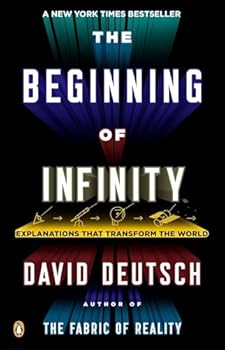
– David Deutsch, The Beginning of Infinity (2011)

 brettworks
Leave a comment