
“…his essay ‘Music Discomposed’, the philosopher Stanley Cavell says that the critic’s first gesture is: ‘You have to hear it.’ Why, he asks, do you have to hear it? Because, he says, with a deliberate risk of tautology, ‘if I don’t hear it, I don’t know it’, and works of art are ‘objects of the sort that can only be known in sensing…Describing one’s experience of art is itself a form of art; the burden of describing it is like the burden of producing it’” (6)
“When I write about a novel or a writer, I am essentially bearing witness. I’m describing an experience and trying to stimulate in the reader an experience of that experience” (6).
“This passionate re-description is, in fact, pedagogical in nature” (7).
“So we perform. And we perform in proximity, exulting in the fact that, dolphin-like, we are swimming in the element that nourishes us. Our prose is our connection to the work of art we are re-voicing. Art critics, music critics, dance critics – to change the metaphor – have to board the boat unnaturally or a little awkwardly, from the front or the bow; we get to board the boat ideally, as one should, from the side, amidships” (9).
“All the critic can hope to do is, by drawing attention to certain elements of the artwork – by redescribing that artwork – induce in his or her audience a similar view of that work” (9).
“Drumming is repetition, as is rock music generally, and [Keith] Moon clearly found repetition dull. So he played the drums like no one else – and not even like himself. I mean that no two bars of Moon’s playing ever sound the same; he is in revolt against consistency, he is always vandalising repetition. Everyone else in the band gets to improvise, so why should the drummer be nothing more than a condemned metronome? He saw himself as a soloist playing with an ensemble of other soloists. It follows from this that the drummer will be playing a line of music, just as, say, the guitarist does, with undulations and crescendos and leaps. It further follows that the snare drum and the bass drum, traditionally the ball and chain of rhythmic imprisonment, are no more interesting than any of the other drums in the kit; and that you will need lots of those other drums. Lots and lots” (19).
“YouTube, which is a kind of permanent Special Olympics for show-offs, is full of young men wreaking double-jointed virtuosity on fabulously complex drum kits rigged up like artillery ranges. But so what?” (20).
“From which emerges the second great principle of Moon’s drumming: namely, that one is always performing, not recording, and that making mistakes is simply part of the locomotion of vitality” (22).
“Moon is the drummer of enjambment” (25).
“For details represent those moments in a story where form is outlived, cancelled, evaded. I think of details as nothing less than bits of life sticking out of the frieze of form, imploring us to touch them. Details are not, of course, just bits of life: they represent that magical fusion, wherein the maximum amount of literary artifice (the writer’s genius for selection and imaginative creation) produces a simulacrum of the maximum amount of non-literary or actual life, a process whereby artifice is then indeed converted into (fictional, which is to say, new) life. Details are not lifelike but irreducible: things-in-themselves, what I would call lifeness itself. The detail about the peppermint, like the tingle felt by Ryabovich [in Chekhov’s “The Kiss”] on his cheek, lingers for us: all we have to do is rub the spot” (53).
“The art of writing is a very futile business if it does not imply first of all the art of seeing the world as the potentiality of fiction” (71).
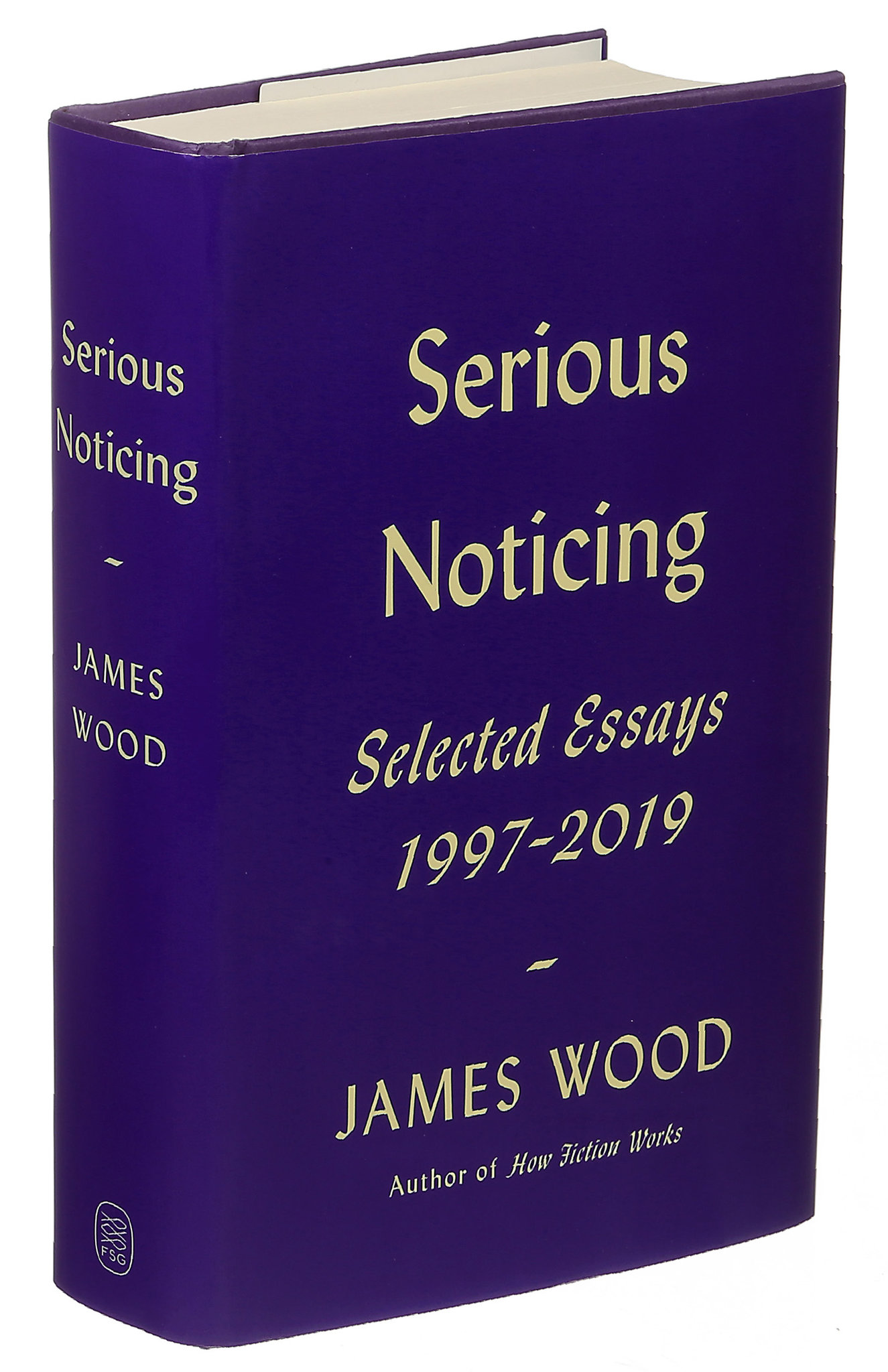
– James Wood, Serious Noticing: Selected Essays, 1997–2019 (2020)

 brettworks
Leave a comment