
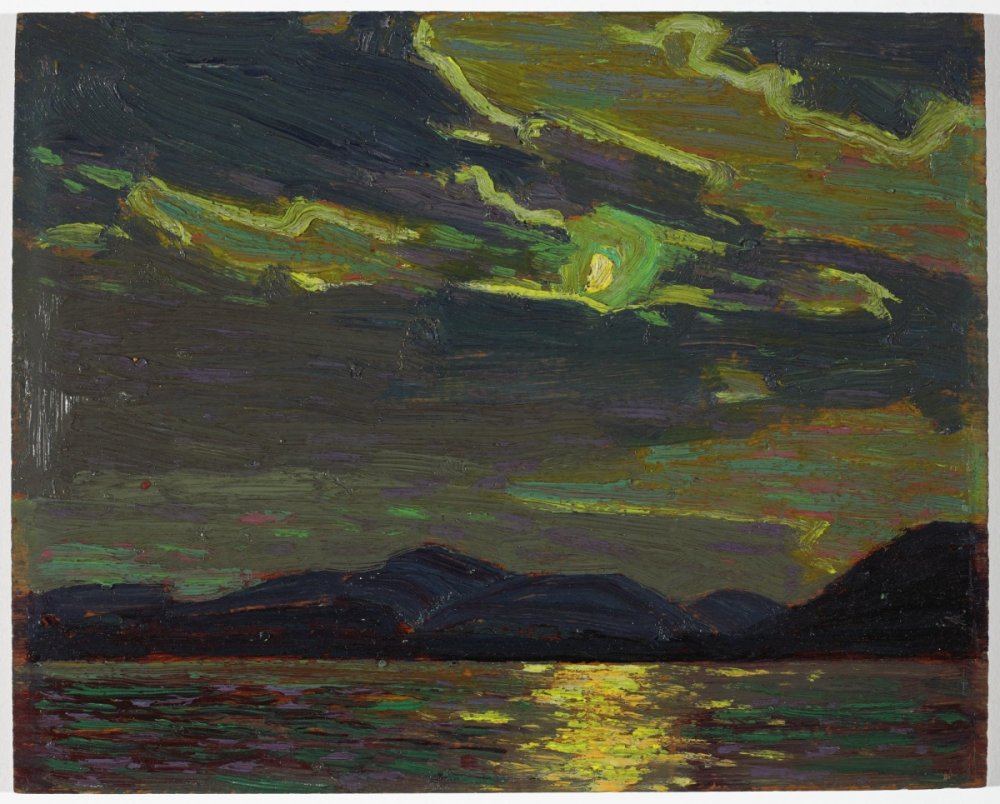
Tom Thomson, Hot Summer Moonlight (1915)
Debussy, Images, Livre II, Et la lune descends sur la temple qui fut (1907). In the early 1990s I spent the evenings of one summer typing up book notes for my mom, who had returned to graduate school to pursue a PhD in English literature. (Her dissertation used psychoanalytic theory as a framework for understanding the novels of Joyce Carol Oates). Mom and I agreed that I would be paid by the hour to transcribe her hundreds of index cards onto the computer for eventual print out. I dutifully logged my time and at a modest hourly wage earned twenty to thirty dollars a night.
Typing appealed to me because I could study the notes’ contents whilst listening to music. Mom had copious and detailed annotations on novels and poems, from the 18th-century to the modern era. I noticed her notes on Wallace Stevens’ poetry. Stevens is somewhat of a music theorist, and my favorite Stevens poems, like “Peter Quince at the Clavier” (1915), position music as a model of human experience. On a shelf at home I would later find Stevens’ collection Harmonium, a book so extensively highlighted that its pages were fluorescent. (We Bretts enjoy taking notes!)
The soundtrack for my transcribing was the piano music of Debussy, specifically a 5-CD collection performed by Aldo Ciccolini. The techniques of Debussy’s atmospheric, modal, and Orientalist-influenced sound have been analyzed and explained. It’s beautiful music. But explanation only elucidates part of a music’s power, maybe because, as Stevens (born just fifteen years after Debussy) puts it in “Peter Quince at the Clavier”, music is feeling, then, not sound. Debussy still sounds modern to us–notice Debussy-style chords in jazz, in pop, and even ambient music, their dissonances and pedal tones lingering. It’s in this way that Debussy constructs space; it was Debussy, by the way, who famously said music is the space between the notes. Piano pieces such as “Et la lune descends sur la temple qui fut” invite the listener into a spacious world of reverie and suggestion, of possibility. As I type the notes, the windows are wide open to the summer’s evening and I can hear the wind moving through the pine tree out back, mingling with the music.

 brettworks
Leave a comment