
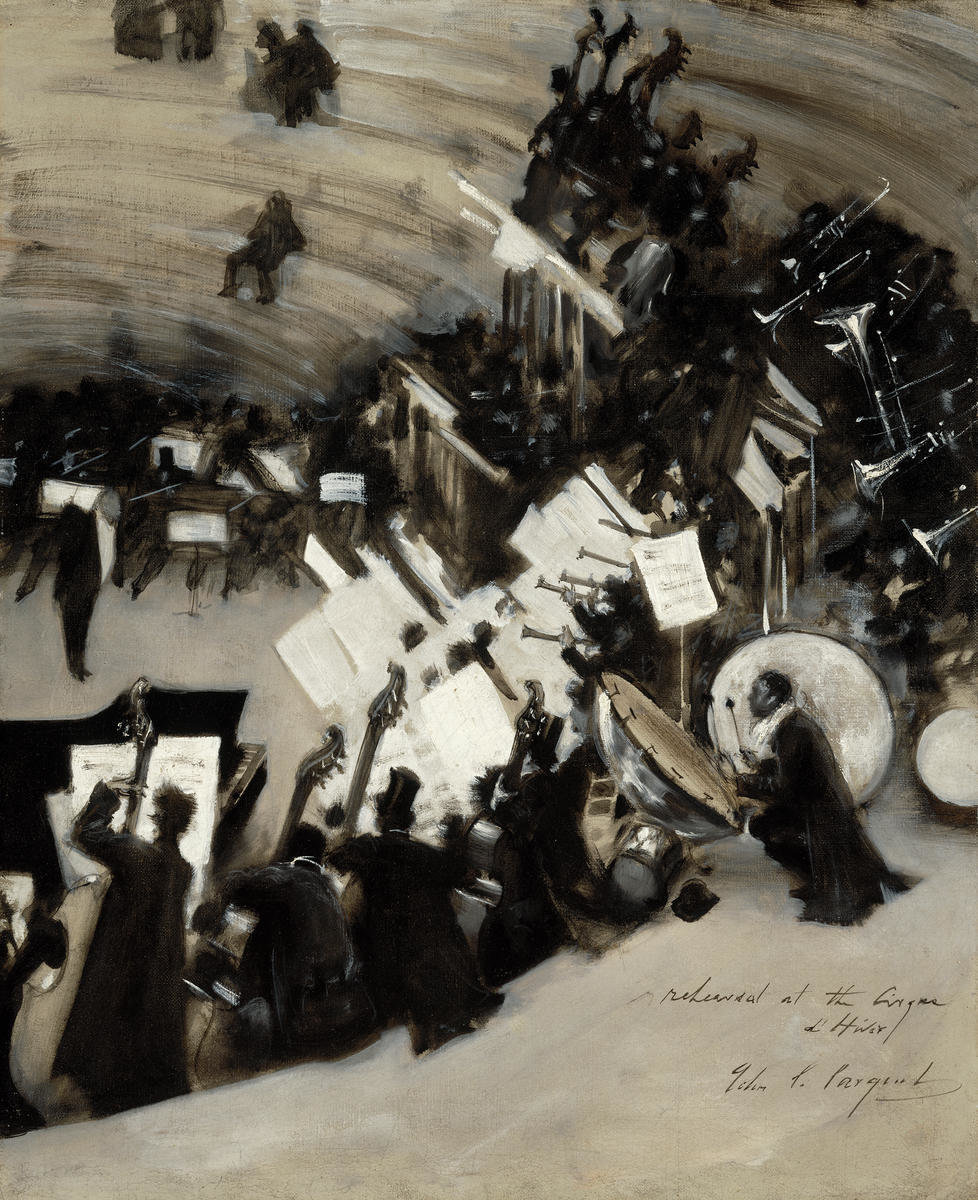
Rehearsal of the Pasdeloup Orchestra at the Cirque d’Hiver (c. 1879-80)
What do musicians think about when they’re playing music? I think about this question often when I’m playing percussion because music seems to stimulate multiple kinds of thinking. The comprehensive cognitive effects of playing and listening to music are of course well documented; music literally “lights up nearly all of the brain” as Harvard Medicine Magazine notes. The musician is thinking constantly as he’s playing, attending to many inputs simultaneously. A NY Times article on the neuropsychology of performance observes how music “compresses so many human capacities into a single activity. It involves at once perception, movement, memory, attention and emotion. It unfolds over time. And it requires constant prediction and adjustment.”
Playing marimba, a large wooden keyboard arrayed in front of me, is like navigating a landscape in which I have to strike the right notes at the right time at the right dynamics. I play parts from memory, but the music isn’t frozen in time. (Although maybe I am.) I still follow the gestures of the conductor (Why are tonight’s tempos fractionally slower?), interact with the other musicians’ lines, improvise in fleeting moments, occasionally lock in with a metronome click in the headphones, and negotiate the inconsistencies of say, a substitute drummer whose wonky time drifts around the click, challenging its steadiness. Playing hand drums is another percussion terrain. The tension and feel of a drum’s head changes each day–drums are alive. When the weather is cold and dry the pitch goes up, the sound is crisp, and the head as hard as a countertop. When the weather is warm and rainy a drum’s tension and pitch fall as the instrument loses its treble but gains boominess. I make constant adjustments to the drums and how I play them, listening for a sound both crispy and resonant.
But I rarely think about details of performance, technique, instrument maintenance, or listening when I’m playing percussion. Perhaps anchored by the ritual of repetition and muscle memory, my mind wanders constantly, jumping from random ideas to specific topics to vague feelings, as if moving along its own time cycle. Some of this wandering I’m predisposed to, but in fact every performance has an emotional geography and the musician is a psychogeographer of that space, moving through perceptions in a landscape of the imagination.
In 1962, the ethnomusicologist Gerhard Kubik wrote a fascinating article about perception in East and Central African instrumental music. Kubik observed a characteristic of zither, harp, and xylophone music whereby musicians playing together produce composite rhythmic patterns “which are not perceived by the listener as they are actually played by the musicians.” For example, if two musicians are playing an akadinda xylophone at a fast tempo, their interlocking patterns will produce patterns within the patterns–little gestalts that jump out of the rhythm texture, a trompe-l’oreille. Kubik called this “psycho-acoustic fact” inherent rhythms, “which automatically emerge from the total musical complex, delighting both the ears of both listeners and players, but which are not being played as such.”
I first read Kubik’s article in the early 1990s and have since thought about it often. I noticed, for example, a similarity between inherent rhythms and composer Steve Reich’s resultant patterns idea, which he pursued in his early tape pieces and many other works in which marimbas are played like akadindas, with interlocking drumming patterns producing emergent melodies. I noticed too that inherent rhythms can be a metaphor for the thoughts that transpire whenever we play music, because the psychological effects of music performance are always emergent. This, for me, is music’s deepest enchantment. When I play percussion, ideas and feelings are conjured as if a psycho-acoustic by-product of the sounds. In other words, what Kubik says about inherent rhythms–that they’re heard by the performer “yet not played as such but arise in his imagination”–perfectly encapsulates the perceptual magic of making music.

 brettworks
Leave a comment