
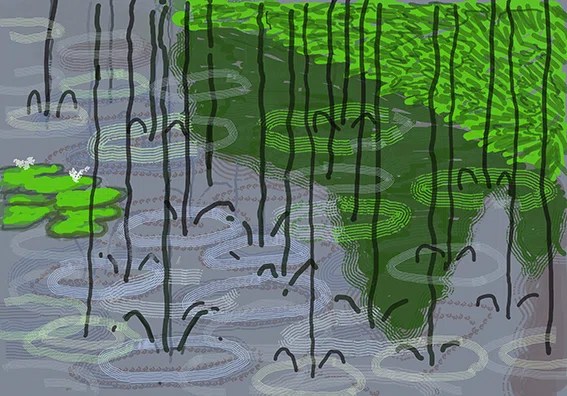
“Each time I do a still life, I get very excited and realize that there are a thousand things here I can see! Which of them shall I choose? The more I look and think about it, the more I see. These simple little things are unbelievably rich. A lot of people have forgotten that. But you can remind them” (20).
“The breakthrough came as a result of reading a poem: The Man with the Blue Guitar by Wallace Stevens from 1937. Its first stanza begins:
The man bent over his guitar,
A shearsman of sorts. The day was green. They said, ‘You have a blue guitar,
You do not play things as they are.’ The man replied, ‘Things as they are
Are changed upon the blue guitar’” (172).
“They play with what he took to be its fundamental, and to him ‘thrilling’, point: that imagination could transform the world and the way we perceive it – and it could do so, according to Stevens’ central metaphor, through alterations in color – or at least in the way that colors are usually experienced. Guitars aren’t generally blue, at least they weren’t before rock and electrification came along. Days aren’t usually green. But Hockney’s etchings play with the idea that you can color the world any way you desire, whether it’s an imaginary realm or a real place” (173).
“…the paintings of splashes were a sort of game with time in which he treated this moment of liquid turmoil with the care of a botanist describing specimens; in other words, he approached it almost like a scientist…but not quite” (187).
“However, the experience of seeing, even when we pay the closest attention possible, is often like that. What we see is relative to us, to our senses, the particular temporal bandwidth on which we operate: a little slower than the speed of a splash, much faster than the erosion of a mountain” (188).
“Likewise, the time it takes to depict something bears little relation to how rapidly it is moving or changing. It might take a fortnight to paint something that is over in a flash. Nor does the small size or short duration of an occurrence mean that it is not significant” (189).
“‘What is stress?’ he asks. ‘It’s worrying about something in the future. Art is now’” (202).
“…you think of it, the acoustics of a recording are the acoustics of another place – not those of the space that you are currently in. You are hearing it in a different room. That must set up a distance” (225).
“‘There’s no such thing as a copy, really. Everything is a translation of something else’” (232).
“[Proust’s À la recherche du temps perdu] is rather a series of moments, and the climax comes when the narrator grasps how the intricate mosaic of his life fits together. It is, as Hockney has said to me, essentially a Cubist way of looking at the world, integrating numerous points of view and instants of time into a whole. (245)
“‘I don’t need to be anywhere’” (252).
“…he has managed to find more and more in less and less” (270).
– Martin Gayford, Spring Cannot Be Cancelled:
David Hockney in Normandy (2021)

 brettworks
Leave a comment