
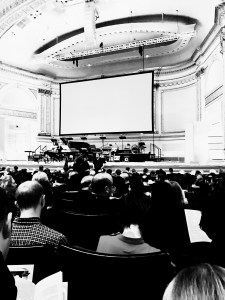
In the concert hall
no one was moving
their body in time
to the music–
not a head nod affirmation,
not even a sway–
only lending their attention
in total stillness.
Which is strange behavior
because this composer’s rhythms,
fours and threes and sixes and twelves,
juxtaposed into poly-layered shapes,
came from African sources
and African contexts,
where music always weaves itself
into the personal,
into kinetic, parallel motions.
Dance music became concert music.
The juxtaposition of lively sounds
and solemn listeners
recalled an old book
in which the master drummer
asks the ethnographer,
“But what can you do with this music, this music
taken from its home? You can do nothing with it.”
Yet here was a taken music,
its elements shorn of their sources,
dancing time shapes
echoing
in a new quiet place.
In the concert hall
no one was moving,
their bodies busy tracking
how the African rhythms
were solving new harmonic questions.


 brettworks
Leave a comment