
“Creative self-expression is the only way we will continue to make our mark as humans in times of uncertainty, and it doesn’t come from doing what you think will sell to other people “(21).
“Antimemetics are a shadow city built on thoughts, knowledge, and practices that do not spread easily, despite their importance to our lives. It is a place where lost wisdom, suppressed beliefs, and uncomfortable truths circulate freely, only to be forgotten once we return to the bright, sunny memetic city. In the antimemetic world, ideas move slowly but deliberately; their integrity is protected from the relentless, compressed cycle of memetic replication” (27).
“Social platforms – Twitter, Instagram, Facebook, Snap, TikTok, YouTube – not only exposed us to more models of desire at unprecedented scale, but encouraged competition by doling out cheap rewards: likes, shares, followers. Like any population exposed to a highly addictive substance for the first time, we were wholly unequipped to handle this level of mimetic desire in our lives” (33).
“Culture wars are a grab for mindshare” (80).
“Supermemes are like an invasive species. When too many supermemes crowd a network, they can threaten its comparatively more diverse and generative creative ecosystem. [Kevin] Simler uses the example of academic research to demonstrate how this works in ‘Going Critical.’ He distinguishes between Real Science, or ‘whatever habits and practices reliably produce knowledge,’ and careerists, who are ‘motivated by personal ambition.’ Careerists ‘gum up the works’ of Real Science communities, promoting themselves instead of contributing to the growth of shared knowledge. As Simler puts it, careerism ‘may look and act like science, but it doesn’t produce reliable knowledge’” (84).
“They may look and act like interesting ideas, but they are primarily selfish, doing whatever it takes to prolong their existence. Supermemes are like catnip for hordes of creative and knowledge workers – technologists, academics, artists, activists. But they are intellectual sinkholes, vacuuming up every resource they can acquire, and when they take over a network, there is little attention left to focus on anything else” (84).
“Focus your attention on something, and it sharpens and becomes omnipresent. Let your attention wander, and the object blurs and fades away” (88).
“Attention is how we carve our personal realities: it is the breathing valve of our consciousness. Selective attention, or the act of focusing on one object at the expense of others, determines what we perceive. Like a flashlight, selective attention illuminates whatever it is aimed at, while other, equally ‘real’ objects fade into the shadows. As I type in a café right now, I am able to write because I’m unconsciously filtering out the café’s music, the murmur of other patrons, and the clatter of baristas preparing coffee” (91).
“If we let others hijack our ability to engage with difficult or complex ideas, we risk shirking our duties as gatekeepers. Giving away our attention to the loudest, flashiest voices in the room ultimately creates a world where we’re all parroting the same set of banal ideas” (102).
“Attention is not something we merely own; it is what we are. Learning to wield it isn’t just about returning to the ‘present moment,’ but rather about creating infinite, dazzling realities – because what we choose to see in the present moment is unique to each of us” (106).
“I want to talk about us as magical wizards of attention, capable of waving a wand and transforming our worlds in astonishing ways” (106).
“The value of an idea is determined iteratively” (116).
“A respectful outsider – someone who is perceived as lacking a personal agenda – often carries special gravity” (119).
“The real purpose of an interesting person is to shepherd antimemetic knowledge into the light” (123).
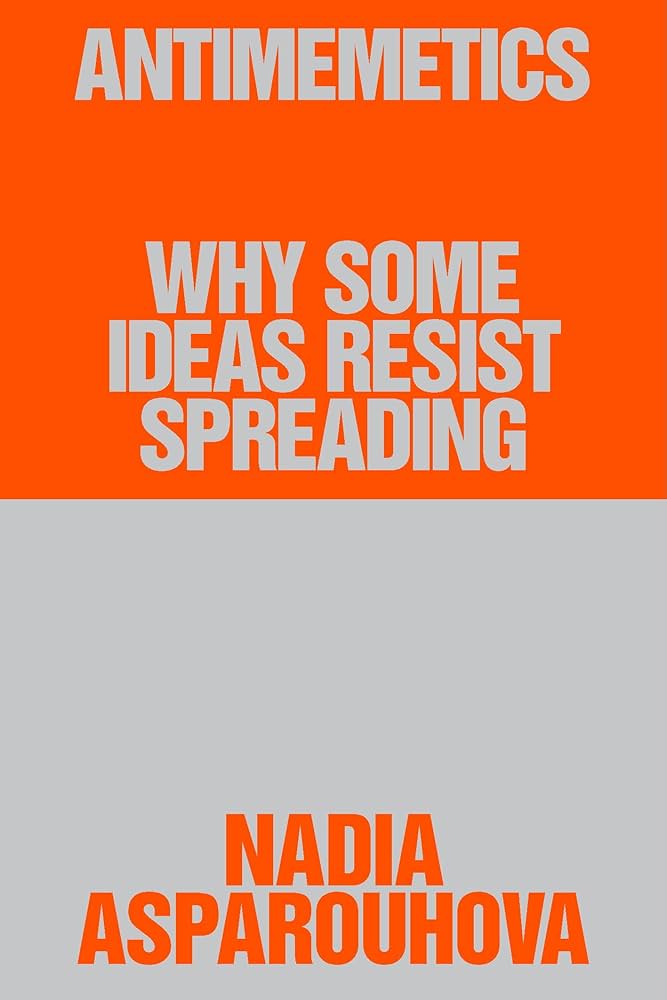
Nadia Asparouhova, Antimemetics:
Why Some Ideas Resist Spreading (2025)

 brettworks
Leave a comment