
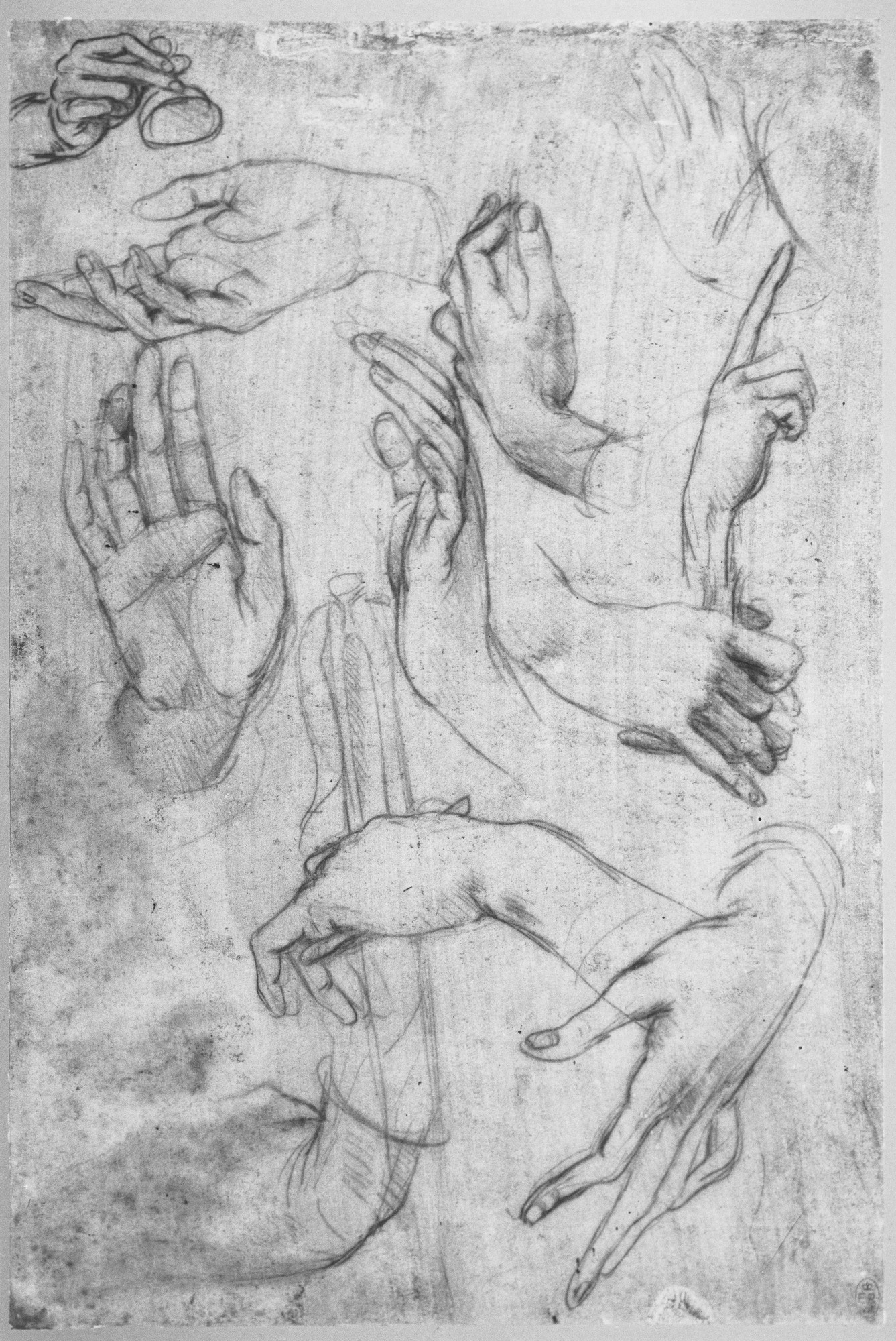
Leonardo da Vinci, Studies of hands (c.1480)
After a week away from performing, I noticed while playing marimba something I never think about. My grip: it felt weak. For a percussionist, grip is the pressure applied by thumb and index finger to make a fulcrum on which to balance sticks and mallets. A weak grip makes this connection feel tenuous and one’s instruments distant, while a strong grip makes sticks and mallets feel like extensions of one’s body.
Applying pressure is fundamental to playing percussion because it’s grip’s expression and the musician’s physical link to expressiveness. To make a sound at an instrument you apply pressure through the grip at the hand’s fulcrum point. The pressure you apply is always different and adjusted to the kind of stick or mallet, as well as the instrument you’re playing. A percussionist’s hands are constantly holding, squeezing, and calculating, but rarely does one think about this little field of action. In fact, until my grip revealed itself because it felt weak, I had never noticed it; I just played. (Don’t worry: a stronger grip returned a day later.)
A string player friend of mine talks about phrasing and intonation whenever critiquing the playing of other string players. He doesn’t talk about technique as much as having an ear for micro-pitch differences and musical line. When I play with other percussionists I notice their time first, then their sense of phrasing and dynamics. Whenever something’s sonically off though, something’s visually off too: the playing looks awkward. A revealing example is playing small basket shakers called caxixi. When you hold caxixi, your arms become like long, three-jointed mallets with seed-filled vessels attached at their ends. But even here grip’s in play–it’s still the fulcrum connecting your arms to the delicate instruments. With caxixi, one’s grip has to be gossamer light to feel (and sometimes visualize) how the seeds are moving inside the vessels and gently direct them. Playing shakers well requires a light grip that allows for relaxed arm movements that look smooth, which in turn help produce rhythms that flow.
To play most percussion instruments–drums, gongs, marimbas–requires striking them with something other than your hand, holding oddly weighted and awkwardly shaped sticks and mallets to interact with stubborn membrano- and idiophones. To hold is to grip and grip is technique unto itself. Like an unseen conductor, grip guides a percussionist’s hands along their musical thinking to make instruments sing.

 brettworks
Leave a comment