
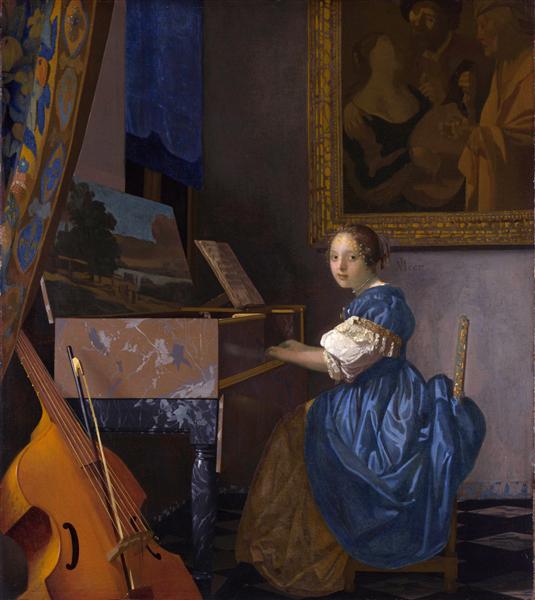
Johannes Vermeer, A Young Woman seated at a Virginal (c. 1670-72)
In MIDI parlance, aftertouch refers to MIDI data that’s transmitted when a key or pad on an electronic controller is held down after the initial attack to control parameters such as volume, vibrato depth, or filter brightness. One of the first synthesizers to incorporate this functionality was the Yamaha CS-80, released in 1977, whose smooth glissandos were used on Vangelis’s Chariots of Fire and Toto’s “Rosanna.” Aftertouch is considered a desirable technical innovation, because it moved electronically-triggered sounds closer to seeming more musically expressive. Using aftertouch, one can elicit some nuance from plastic keys and rubber pads. Touch a key, then press it down some more to emote.
Interestingly, the earliest known reference to aftertouch was Charles Snell’s 1712 book, The Art of Writing. Snell was a master of penmanship, and used aftertouch to describe the stroke made after an initial pen action. An aftertouch, he writes, is a corrective reshaping of a letter applied with flair–a delicate movement of the quill. Snell’s work was part of a movement to standardize the handwriting—basically, early fonts—that would be used by accountants for British trade. But aftertouch was also about the aesthetic power of typography. As a letter to Snell from a friend reproduced in The Art of Writing’s Preface puts it: “In every Letter is a lively Picture, and every Word makes the Picture speak.”
While aftertouch functionality never existed prior to electronic controllers, keyboardists have been theorizing touch since around the time of Snell’s writing on penmanship. A reason for this is that the instruments of the time, the clavichord and harpsichord (forerunners of the modern piano), had their limitations. The clavichord is very quiet, and the harpsichord sort of loud no matter how it’s played. In his 1753 book, Essay on the True Art of Playing Keyboard Instruments, composer Carl Philipp Emanuel Bach (the fifth child of J.S. Bach) observed “the growing beliefs that to play slowly or legato is wearisome, that tones can be neither slurred nor detached.” Unlike the keyboards of his time, Bach lamented, “all other instruments have learned how to sing.”
In his 1716 book, L’Art de toucher Le Clavecin (The Art of Playing the Harpsichord), composer François Couperin acknowledged that the weakness of the harpsichord is that it can’t increase or decrease the volume of a note after the note is played. Couperin outlined a system of articulations meant to trick our ears into hearing more expression in keyboard playing, from a sense of breathing (“l’aspiration”) to a sense of silence (“le silence”). A player, he said, should “glide” from one note to another which can be accomplished by careful legato. And aural illusions of “sighing” or “accenting” can be achieved by playing with a note’s duration, holding or releasing it just so. In providing practical approaches to realizing ideals of feeling, soul, and suspense, Couperin thought about music in ways that are still modern, still relevant:
“The feeling or ‘soul’, the expressive effect, which I mean, is due to the (cessation) and (suspension) of the notes, made at the right moment, and in accordance with the character required by the melodies […] These two agrémens [embellishments], by their contrast, leave the ear in suspense, so that in such cases where stringed instruments would increase their volume of sound, the suspension (slight retardation) of the sounds on the Harpsichord seems (by a contrary effect) to produce on the ear the result expected and desired.”
Today, an advanced MIDI protocol called MPE (MIDI Polyphonic Expression) includes aftertouch as well as independent control of pitch and timbre parameters for every note to help a controller achieve acoustic-instrument-like expressivity. On an MPE controller such as ROLI’s Seaboard, Expressive E’s Osmose, or Ableton’s Push 3, one can slide one’s fingers around the surface of the keys or pads to flatten or sharpen a sound’s pitch, add vibrato, or change volume. Very cool. But MPE controllers are expensive and have been slow to catch on, perhaps because they require new playing techniques for an instrument whose design has been unchanged for centuries. Moreover, while music producers want their work to be expressive and capturing nuanced performance via a dynamically varied improvisation is a key part of the composing process, there are many, many other ways by which to build expression. Field recordings and samples bring real life into a track’s soundscape, counterpoint, arrangement and mix conjure a world, and repetition enthralls. These elements and techniques help create a music that sounds alive at many levels at once. All this to say that aftertouch, and trying to avoid the pitfalls of uncanny valley-tinged realism, may not be all that important to composers who use a computer and its softwares as their primary instruments of invention. We want our music, as Courperin put it, to leave the ear in suspense, and now we have an excess of tools and techniques for making that happen.

 brettworks
Leave a comment