
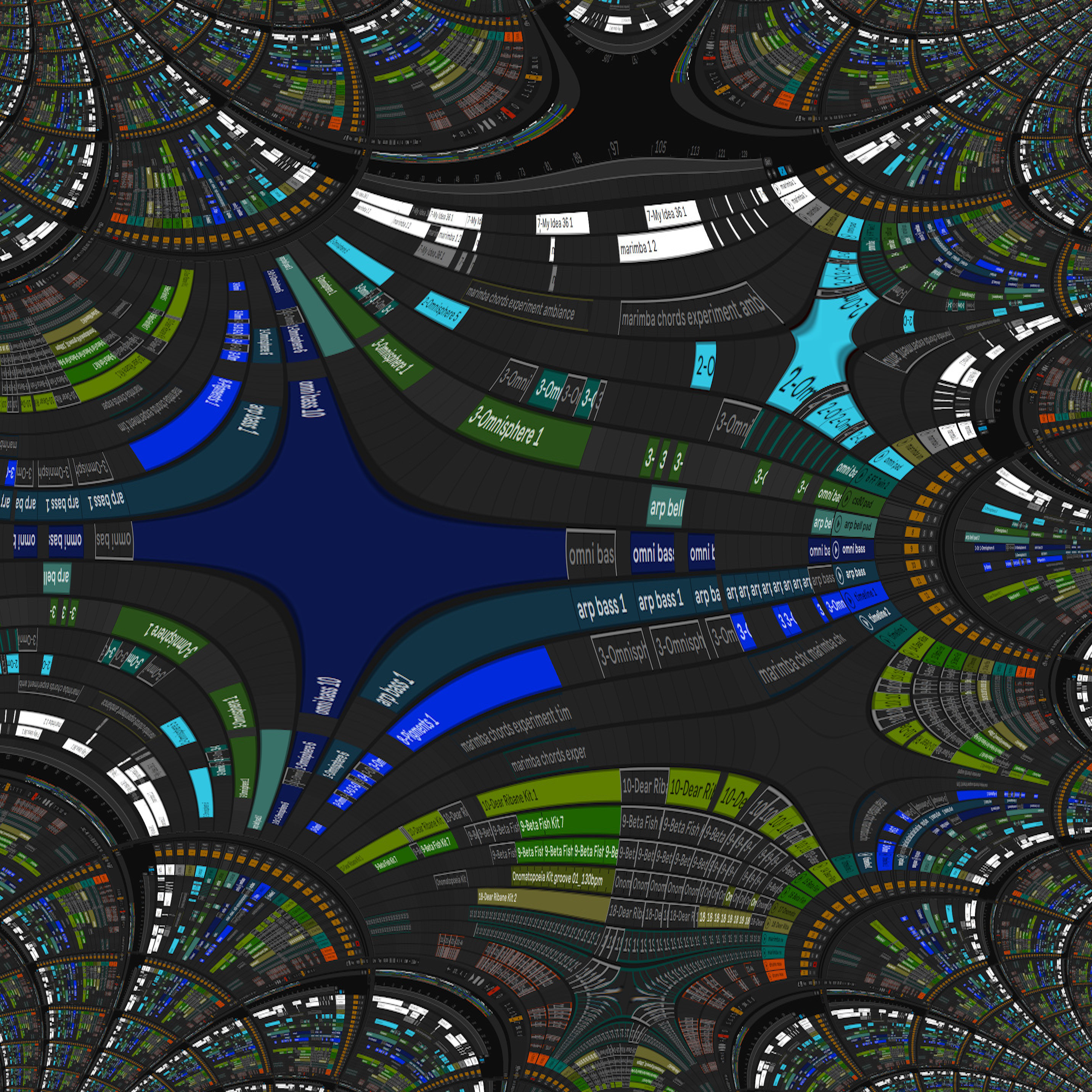
The brief moments in which many musical projects begin feel stolen because they are as if outside of time, free from routine, surprising, and rich in delight. They’re powerful because they’re witness to something new happening. But how does this unfold?
As usual there’s no plan, I’m just exploring—clicking on sounds, moving audio around, or playing something. Maybe I’ve dragged a choral recording onto a track to listen through. I notice an interesting phrase and copy it to another track. One phrase at a time, promising bits suggest themselves to me, and soon I have a small collection. Or maybe I’ll click through sounds on an instrument until I find something unusual. What’s this sound? What are its sources? How can I change it—make it fatter, thinner, more percussive, more angular? I play parts on the sound and play with its parameters. What’s the sound suited for? What’s it saying and in what context might it say more? I’m amazed how tiny changes to a single parameter or setting I half understand reveal a sound’s world and its emotional potentials. “Reality” as John Salvatier notes in his essay about perception, “has a surprising amount of detail.”
Let’s zoom in further on detail: stolen moments always seem to be liminal, having within them turning points when one commits to try something. For me, it’s juxtaposing two different parts or sounds to hear what will happen. How would those choral voices sound with this weird bass? There’s no reason they should get along, but they do have in common a listener who heard something in each. I find a low tone to hold under the voices, a drone ally who suggests without directing, a horizon upon which the samples can harmonize themselves. The tone is a placeholder, but who knows…Could this work?
Over the span of a few minutes, I try out a slew of What Ifs to explore the boundaries of this moment. At the same time though, I want the music’s options to stay fluid, open-ended. The samples are of irregular lengths and positioned ad hoc on the timeline. That’s perfect; I’m reluctant to edit or arrange too much this early. Instead, I play along with the voices, adjusting to the rhythm of where they are. I play and record something quickly, knowing that I can finesse later. Resist the square, the 4/4 grid thinking, the lining up parts into tidy rows of perfectly-spaced objects—that’s too easy. “Automatically take the toughest route” advised the sculptor Richard Serra, who was expert at bending steel. “Everybody else is taking the easiest one.”
The mix of two contrasting, irregularly-shaped, and not totally defined parts interacting is a wonderful sound because it suggests potential. All I need to figure out now is how to make everything fit together.

 brettworks
Leave a comment