
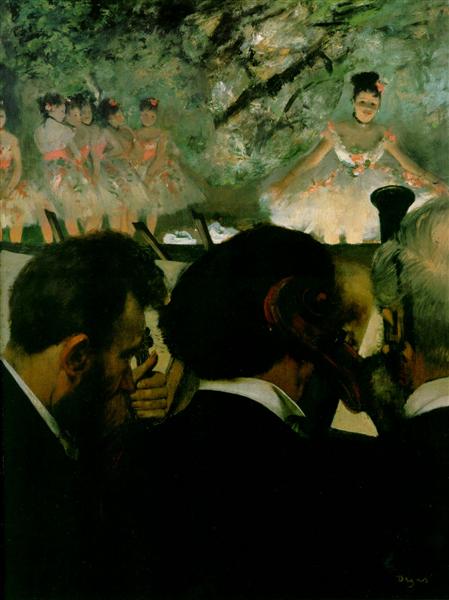
Edgar Degas, Musicians in the Orchestra (1872)
“There’s a whole orchestra down there. This is where all the music happens.”
“Look—he’s playing a huge xylophone!”
“He’s trained his entire life to learn those instruments.”
At the show over the past few years I’ve noticed more and more curious audience members peering over the pit at intermission. Some parents explain to their kids–who have probably spent more time in front of screens than attending performances–that this is where music happens. The young ones say “Hi” and wave, so I say Hi and wave back. (Sometimes this repeats for a while.) Everyone seems surprised that twelve feet beneath them is an orchestra, and really surprised to see two percussionists amidst dozens of drums, shakers, gongs, and mallet instruments.
“Is that a large xylophone?” a woman asks from above.
I look up. “No it’s a marimba.”
“Maroomba?”
“No, ma-rim-ba. It’s like a xylophone but in a lower register.” I play a few bass notes to demonstrate.
“Whoah, that’s so cool.”
“It is cool.”
“How long have you been playing here?”
“About twenty-nine years.”
“Wow, that’s amazing.”
•
It’s easy to be surprised that Broadway shows still use live musicians because recorded music is everywhere and available whenever and however we want it. Music has been a commodity since the 1950s, and since 2006, when Spotify appeared, a utility. In the streaming era music is cheap: for about 30 cents a day the entire history of music is yours. Recorded music is cheap because it’s omnipresent and functional, soundtracking TV commercials, retail, restaurants, films, social media, and everyday life as we commute or exercise in headphone cocoons. The musics used in the detergent ad, the action movie scene, the pop song chorus, or the YouTube vlog are different yet serve a similar purpose, which is to prevent silence while leaving barely a meaningful trace.
For an audience, a score played by a theater orchestra night after night is yet another kind of functional music, but for musicians who play the score it’s more than that. Playing music and consuming music are, after all, different modalities. A listener may be intently listening, half listening, or mostly ignoring a music while doing or thinking about something else. But a musician playing is all in. Playing music is somewhere between an athletic pursuit, a memory puzzle, and a meditative journey in which the first moments never predict the experience thirty or sixty minutes in. I think the reason for this is that a musician goes somewhere cognitively when playing. Maybe the musicking body summons various kinds of felt knowledge through sensing, associating, remembering, and imagining. Is playing a musical instrument then, a kind of intensified learning? In the flow of playing, a musician is constantly learning about his instrument, its connection to his life, and how to create energy. Playing music is giant feedback loop.
Every performance has its own energy, and each musician feels this energy a different way. One morning a colleague from the string section calls me. “Did last night feel sluggish to you?” he asks. It did. We speculate on whether the conductor, the cast, the audience, or the orchestra was to blame. “It just felt dead to me” he confides. Some nights begin low energy and then gain energy. How does that work? An audience–who’ve paid a lot to see the show–bring the energy of their expectations. The conductor, who models a theatricalized intensity (serious face, incisive cues, grand gestures to mark the time, etc.), brings the energy of leadership. But to me those energy sources are secondary–and maybe more reactive than generative–to the musician’s labor. No music happens without this labor; a score is dead until skilled musicians bring its notes to life. A performance’s primary source of energy is summoned by musicians who can precisely and repeatedly coax their instruments to speak and their parts to coalesce into an integrated whole.
In an era when, as listeners, we can immerse ourselves in any music we choose, almost without cost, there’s an agency to playing music that’s singular and analog. In the same way analog recording captured continuous sound waves as electrical signals, to play an acoustic musical instrument is to generate sound powered by the continuous physical vitality that is your life, a hypothesis that works for a while. Agency entails skin in the game: the musician is solely responsible for her sound. This sound is real time, no-backsies, uneditable, un-AI’able. The stakes are high because margins for error are tiny and your sound is who you are. For the percussionist, every drum stroke or mallet strike on vanishingly quick-attack and decaying instruments starkly reveals one’s tone and timing.
The energy of a musical performance is fragile in that it can dissipate for a million reasons–from sloppy playing, lack of phrasing, harsh tone, a dragging or rushing tempo, or even just a weird vibe. (Interestingly, “wrong” notes are never as damaging to a performance as one might think.) A musician maintains intensity by staying tuned in to the unfolding music, experiencing with the other orchestra or band members a shared sense of time that sociologist Alfred Schutz called “living through a vivid present together.” A musician who’s always deeply listening is what we aspire to be: aware within music’s flux and making continuous micro adjustments in the vivid present of performing to keep our playing tuned in, in time, and alive.


 brettworks
Leave a comment