
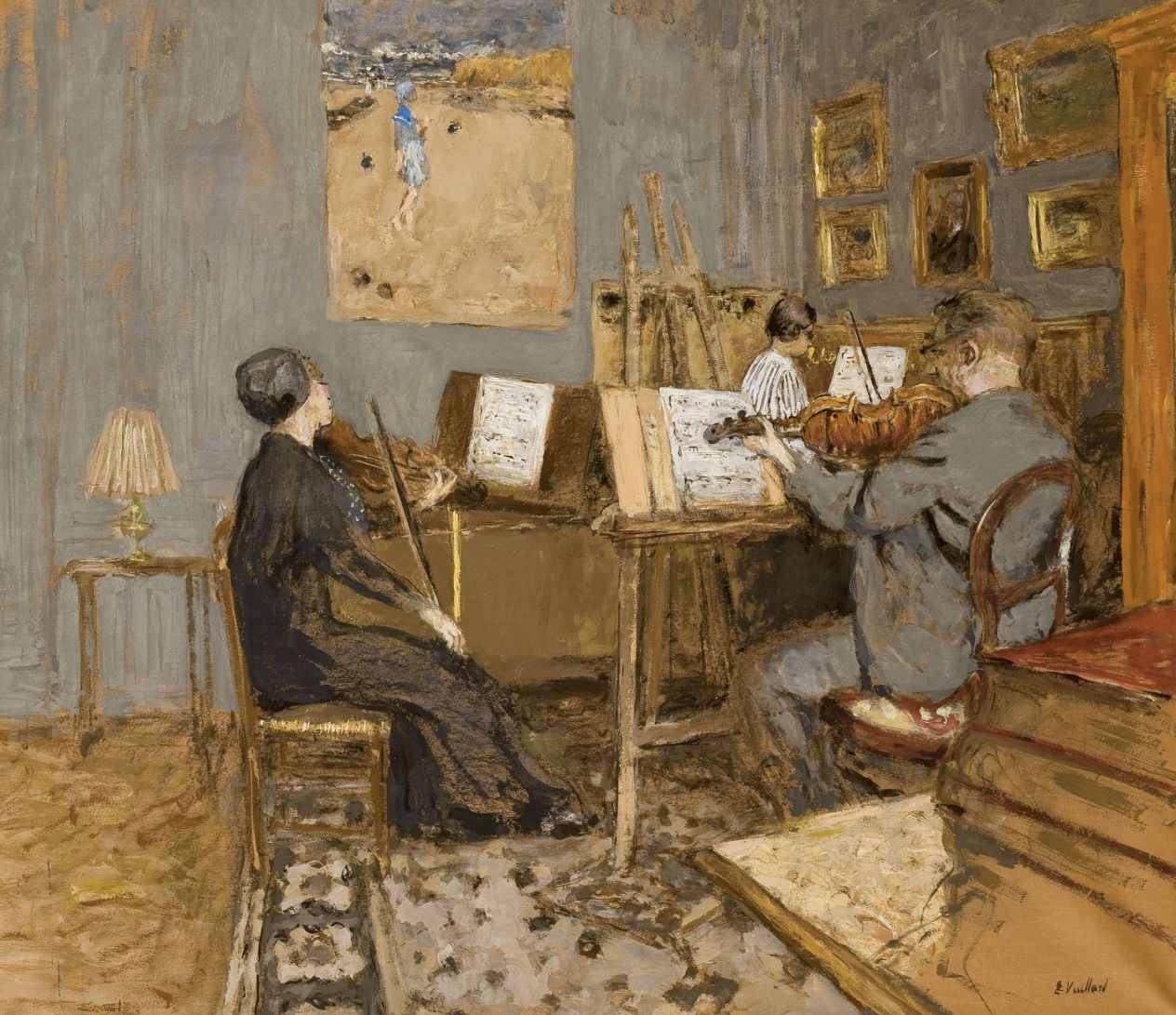
Édouard Vuillard, Morning Concert (1937-38)
Why do we turn to music when there are so many other artistic, physical, social, trivial, and spiritual pursuits claiming our attention? One reason is that music is a multimodal experience that is already meaningfully integrated into our lives. Music is everywhere as a tacit shared language, a perpetual underscore to everyday life that suggests, celebrates, and sells our values back to us. Another reason we turn to music is because it feels like a world unto itself, alive at many levels at once and imbued with a strange power to model, or mirror, or symbolize relationships in the “real” world outside it. Music is enchanting in how it touches everyone within ear reach of its vibrations.
When I’m composing I sometimes find myself wondering about what music does for me. A moment after sitting down and before getting into a flow, questions appear like harmonics dancing off a vibrating string. What am I doing? (Not entirely sure.) Do I need to do this? (Ditto.) Am I trying to express something? (Maybe?) Or am I exploring something? (We’ll see!) In general, composing feels difficult, rather slow, but worthwhile in a way that’s hard to measure.
In my experience, a composer is a complex problem to which her music is a response. Composing is an ever-changing (and hard to measure) response that proposes process as a way forward. When we compose we’re building a virtual model of a world of feeling and meaning. Using chords, melody, rhythm, and texture, we tune in to our senses, our moods, our surroundings. Tuning in brings us out of ourselves–out of the personal Me into a We world shareable with others.
If you think about all the things music can do, it becomes clear how the right music can be a powerful tool for our well-being, what Steward Brand calls “the whole grand process of keeping a thing going” (The Maintenance of Everything, 2026, p. 8). Among its many enactments, music articulates complexities, presents ambiguities, conjures moods, provokes and energizes, calms and seduces, harmonizes, synchronizes and entrains, compels dance, and animates words as melodies. The scope of these enactments makes music unique. Painting and writing, for example, do some of these things, but they don’t offer music’s combined intellectual, emotional, and vibrational wallop.
We turn to music then, because we can use all of its sensations and ways of being as tools with which to maintain our stable equilibrium. Composers always have a frame for their music, from setting a mass, scoring a film, to writing a song or producing a beat. But within the constraints of this frame, composing explores the potentials of structure and process and soon a multimodal world appears again. Whether model, mirror, or symbol, music teaches us as we tune in to its enactments. This is how composing is a response to complexities in ourselves we don’t know about until we hear sounds that seem to express them.


Leave a comment