
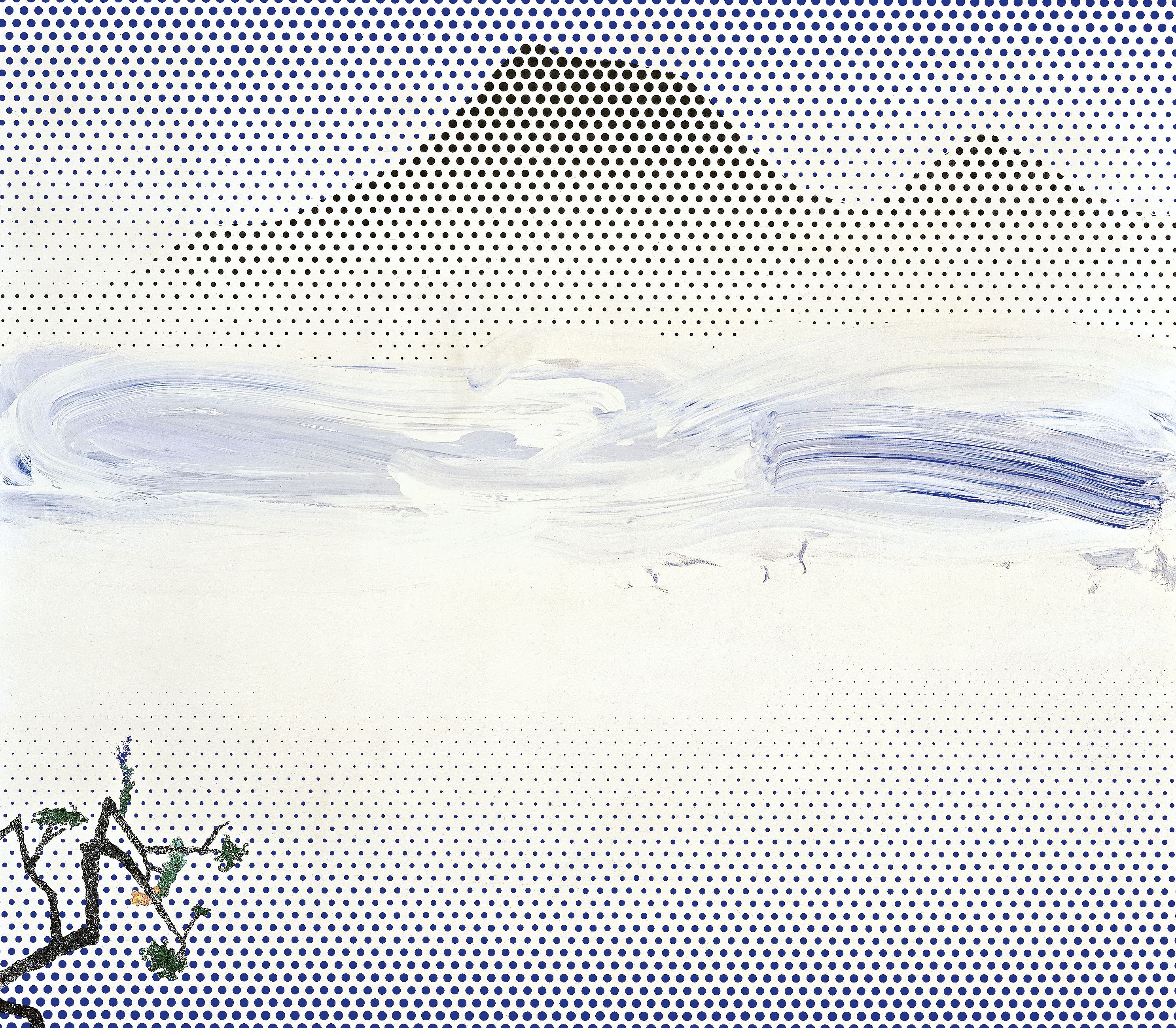
Roy Lichtenstein, Landscape in Fog (1996)
• An essay about making early digital art.
“It’s 1990, and I still don’t know where the darn tiger comes from. But I do know that there’s no program that will draw one from scratch, any size or pose or color or style, like I want it, without an artist at the helm. And there’s no magic answer for us artists except that we are each unique. We are the only variable. You can have identical setups: hardware; software; memory; working conditions: and the artists, left to themselves, will create totally different work. So don’t be intimidated by brilliant programmers, software publishers, technological wizards, and hardware junkies, and if they sneer at your lack of technological expertise, ask ‘em why they never bothered to learn to draw. We are none of us much without the others.”
• A tutorial by Dan Worrall that clarifies mastering.
“I can finally revel my secret mastering chain…It’s just a limiter. Nothing else…I’m suggesting that if you’re mastering your own mixes, you should do the same. Not because it’s wrong to process your stereo mix to give it that final polish and shine, but because you’ve already one that’s on your mix bus and you didn’t bounce the mix until you were 100 percent happy with what you were hearing.”
“At one point in our conversations, [Iason] Gabriel described himself to me as ‘a card-carrying humanist’: he is not the sort of person who looks forward to a day when superintelligent machines render humanity obsolete. Still, he recognizes that as computers encroach on activities and capabilities that we have long held to be the special province of Homo sapiens – language, creativity, humor, taste – we find ourselves thrown back on some of the oldest and most difficult philosophical questions of all. Just as discoveries in physics, biology and astronomy led past generations to revise their understanding of what makes our species distinctive, he suggested, so, too, might AI prompt us to reconsider what it means to be a human being.”


Leave a comment