
“Art is what happens when an artist has a big, numinous, irreducibly complex feeling in their mind, which they infuse into some artistic medium—a book, a song, a dance, a painting, a photograph, and such—in the hopes of making a facsimile of that big, numinous, irreducibly complex feeling materialize in the minds of people who experience their art” (92).
“Somewhere along the way, something very weird happened: I started to understand [Joseph] Keppler’s communicative intent at a level that I had never guessed I would. Keppler’s lines, his erasures, his overdrawing and crosshatchings, they all say something, something that can’t be put into words, only into brushstrokes. Somehow, by decomposing Keppler’s works to their most foundational units, I found myself gaining an insight and appreciation into their totality that I never imagined I’d find. I’m convinced that this is down to the communicative intent of these individual markings, the fact that each one of them reflects a choice by an eminently talented and skilled professional who had devoted many, many hours to his craft, which let him make better art, because it gave him a vocabulary of hand and brush and eye and line that conveys textured subtleties that we, as his audience, may never consciously notice, but that we experience when we see his work” (95).
“How many decisions should a work of art embody?” (96).
“They call it ‘generative AI’ but it can’t generate any meaning. All it can do is add vaporous filler to the meaning that is contained in a human user’s prompts” (99).
“This is why AI art is often dismissed as ‘soulless,’ but I think a better term is ‘eerie.’ In The Weird and the Eerie, Mark Fisher describes eeriness as ‘when there is something present where there should be nothing, or is
[sic] there is nothing present when there should be something…’ But eeriness has a tendency to regress to the mean. The only reason the brushstrokes have the seeming of intent is that we haven’t ever encountered brushstrokes without intent. Once we become accustomed to
brushstrokes without an intender or an intent, the brushstrokes lose their seemingness, and they become empty. That’s where the soullessness comes in” (100).
“Brilliant photographic portraiture isn’t merely the product of mastery over a camera or a darkroom—rather, that mastery allows the photographer to anticipate the likely output of the machine based on how they operate it, and their artistic talent allows them to recognize, capitalize on, and refine the unexpected happy accidents arising from the uncertainty intrinsic to operating such a machine” (103).
“…the way you learn to paint is by painting in other people’s styles, and the way you create your own style is by adapting, merging, distorting, and rejecting others’ styles” (132).
“John Philip Sousa went to Congress in a fury over musicians recording his sheet music and selling the records, when he said: ‘These talking machines are going to ruin the artistic development of music in this country. When I was a boy…in front of every house in the summer evenings, you would find young people together singing the songs of the day or old songs. Today you hear these infernal machines going night and day. We will not have a vocal cord left. The vocal cord will be eliminated by a process of evolution, as was the tail of man when he came from the ape’” (145).
“A conscious being isn’t a word-guessing app that knows more words and has more computing power to guess with. Throwing GPUs and training data at AI isn’t going to make a superintelligence (and no horse is going to
foal a locomotive)” (149).
“That’s the thing about actual, existing AI: the lucrative present-day use cases, from drone warfare to wage theft, from empiricism-washing, racist policing to ripping off shoppers, are pretty ghastly. To be an effective AI critic, you need to strike at the source of AI’s power, which is the investment capital it attracts. That investment capital is attracted by speculative stories about how AI will someday do our jobs, and by the
reality of AI being used today to rip us off and to automate lucrative human rights abuses at scale. If you want to stem the tide of AI investment, it’s imperative that you don’t get distracted by Geoffrey Hinton’s hyperventilating about the ‘existentially serious’ risk of ‘these things getting more intelligent than us and taking over.’ It’s vital that we don’t conflate ‘an AI salesman convincing your boss to fire you and replace you with an AI that can’t do your job’ with ‘AI will steal your job.’ It’s essential that we never stop reminding people that the current, actually existing lucrative uses for AI are terrible and should be banned” (170).
“AI art is uncanny because it has the seeming of intent without an intender, and it grows more meaningful the more a human infuses it with communicative intent” (208).
“If we are good AI critics, if we carefully identify the pathological aspects of AI and relentlessly target the financial basis of the AI bubble, we can make sure that all the terrible things billionaires want to do with AI
never happen, and we can consign all the terrible things that are currently being done with AI to history’s ash heap” (213).
“The AI scientists who dreamed of better interfaces and came up with the techniques underpinning image generators and large language models did something incredible. We will doubtless find ways to refine and use
their inventions for many years to come. But they haven’t invented an intelligent being. They haven’t set in motion the tools to conjure up a new god or demon. They haven’t even invented a tool that can do your job
for you” (221).
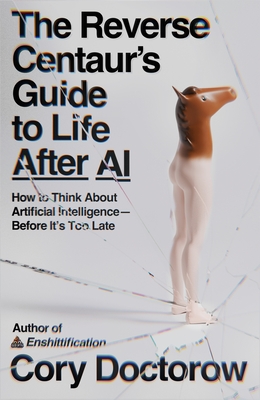
Cory Doctorow, The Reverse Centaur’s Guide to Life After AI (2026)


Leave a comment