
“I will always remember that circular movement of my photography director’s hand, and now I know that what we miss in every digital device, and more in general in the digital world, is that breathing, that waviness, that irregularity. Like a vibration. Was that vibration what we used to call a soul? It’s hard to say, but if, like me, you keep on looking for answers, this is the answer that comes to me: a vibration is a movement that makes reality ring true; it is an unfocused image where reality breathes in meaning; it is a delay where reality produces mystery. It is, therefore, the only depository of real experience. There is no real experience without a vibration of this kind.”
Alessandro Baricco, The Game (2020)
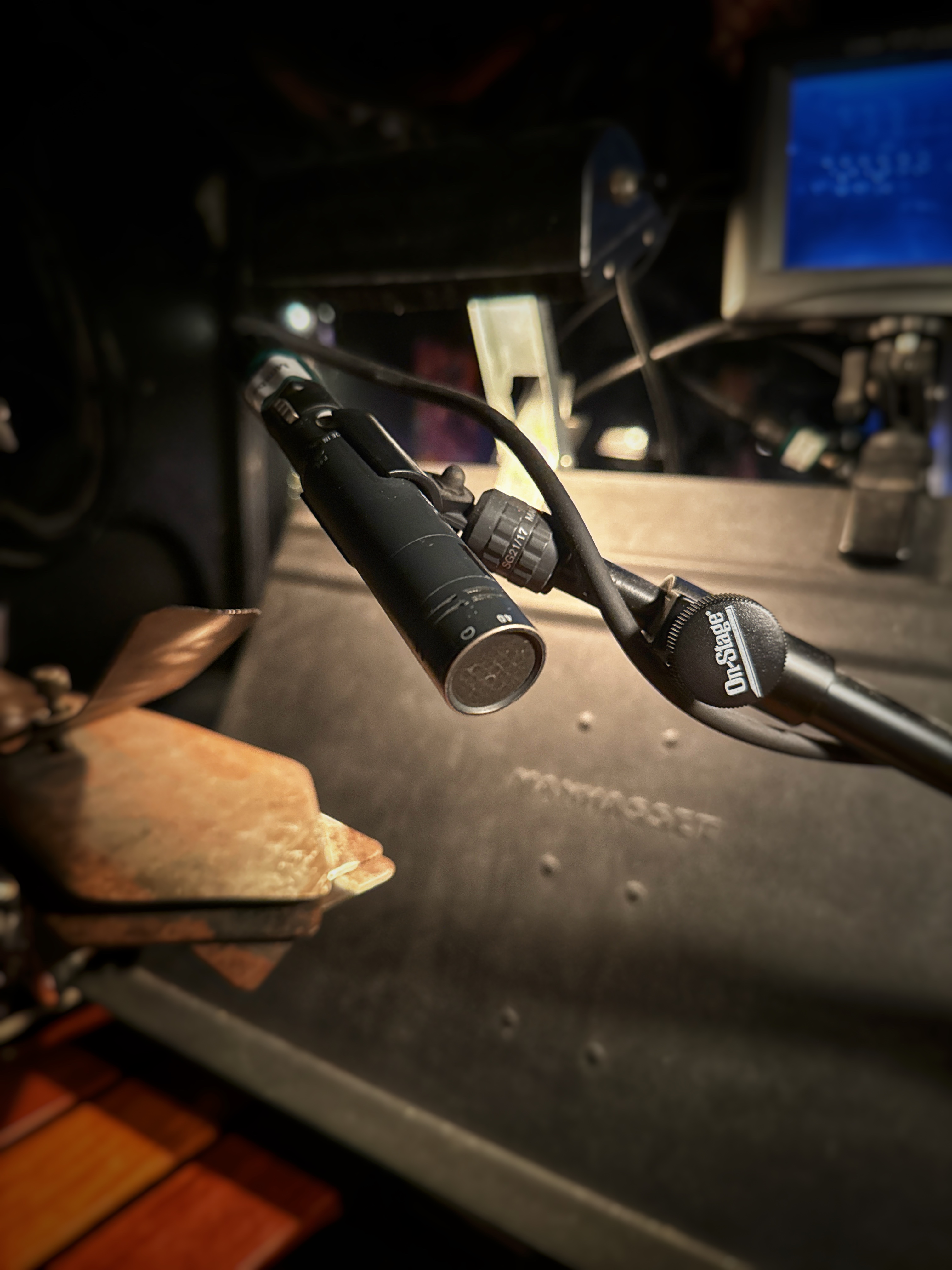
I’ve spent years in front of this microphone on the left side of the marimba, playing various percussion instruments that shake, rattle, and roll. The microphone, like its counterpart over on the right, is there to hear my sound and send it along hundreds of feet of cable out to a mixing console at the front of the house where it’s blended with the rest of the orchestra’s parts and the combined sum sent to the sound system. From mic to speakers, this signal chain electronically hears, transduces, and amplifies sound almost instantaneously: as I strike a marimba bar someone in the back row of the theater hears the instrument’s tone like a phantom presence, as if it’s right in front of them.
When playing I wonder about how the way the microphone’s “hearing” differs from my own listening perspective. One difference is that, while a microphone can hear more, it doesn’t listen because it can’t subjectively filter. I once made a field recording of Times Square as I walked through it. I wanted to know if a recording would match my perception of the place. When I listened back I was surprised to hear how old-fashioned the soundscape sounded; I almost didn’t recognize it. I heard footsteps, fragments of conversation, distant musics, passing cars, and even the clickety-clack of horses (there happened to be mounted patrol officers that night). In other words, the soundscape as recorded didn’t sound like how I perceived the feel of the place as I walked through it. And the reason for this is that the microphone on my phone simply recorded all that was audible. Unlike a set of human ears, it didn’t subjectively filter anything–it didn’t, for example, zoom in on one detail in the spectrum of sounds unfolding around me just because it was curious about it. In contrast, people constantly filter. I noticed the sight of the horses more than their sound, and I didn’t notice people talking because people are always talking so I tune it out.
While a microphone hears what’s in front of it (directionally) or in its vicinity (omnidirectionally), musicians hear holistically, with their whole body. If I’m playing marimba, there’s the attack of the sound as my mallet makes contact with a bar, and there’s also the sustained tone of the sound that resonates immediately after that attack. As I strike the bar its vibrations pass through the mallet up into my hands and arms. I hear the instrument’s sound coming up at me, but also sort of around me, like a halo. It can sometimes feel like I’m vibrating as much as the instrument is. And both the sound of the instrument and its felt vibrations provide information about how to adjust for the next note. My grip on the mallets is thus a constantly changing fulcrum: it isn’t a death grip, nor is it loosey-goosey. The feeling of the instrument’s changing vibrations keeps me dialed in, ready to pounce, connected.
If we were to make a recording of what the microphone hears of my playing, it would sound predictably consistent in terms of dynamics, tone, and time. But the experience of playing is more undulating. A musician’s listening is a continual breaking wave of attention. As the music cycles along, so too do musicians ebb and flow, bobbing up and down upon sound’s currents. This creates the sensation that one is somehow thinking through sound. As David Abram writes in Becoming Animal (2010), “I was thinking, yes, but in shifting shapes and rhythms and dimly colored vectors, thinking with my senses, feeling my way toward insights and understandings” (112). Maybe this is the reason why playing a musical instrument is never boring because you can always find something–a tone quality, a moment of sync, a phrasing possibility–to focus on.
Another difference between how a microphone hears and how a musician listens is that musicians come to sound in the context of all they’ve ever heard. The microphone, which has neither lived experience nor a history of listening it can summon, is a dumb, always-on high-resolution aperture. The musician though, has both a musical history and a life history to draw on. This means that every time we make music we’re on some level relating it to every music we’ve ever encountered. (Even novices or lousy musicians have a history that guides them in making quality distinctions.) Even more interesting is how musicians weave their lives outside of music into their listening. Sometimes I’ll notice that my playing is triggering a sequence of feeling, remembering, and sensing. Even though the moment is fleeting, I notice how a way of playing reminds me of my teacher; that a crescendo reminds me of ocean whitewash; that a chord evokes Messiaen. As musicians play with control, their limbs occupied and guided by muscle memory, their minds circle above, unravelling hidden associations, connections, meanings, traumas, and joys. Like the bird in J.A. Baker’s The Peregrine (1967), we remember patterns we didn’t know existed, finding our “way across the land by a succession of remembered symmetries” (35). The microphone in front of me hears a musical performance, but misses my musical experience.

 brettworks
Leave a comment