

Jost Amman, Der Lautenmacher (1568)
“Everyone knows what attention is. It is the taking possession by the mind, in clear and vivid form, of one out of what seem several simultaneously possible objects or trains of thought. Focalization, concentration, of consciousness are of its essence.”
William James, The Principles of Psychology (1890)
“Reality has a surprising amount of detail.”
John Salvatier
Producing music can sometimes feel like making a thousand small adjustments to a thousand parameters—fine-tuning parts, timbres, effects, levels, and relationships until coherence emerges as if by magic. While the adjusting is done sequentially (you can’t change everything at once), the musician is inescapably attending to everything going on in a track. Producing, then, makes intense demands on one’s attention and requires a fluency in what I call omnimusicality, which means being able to move among different listening modalities as a composer, performer, sound designer, arranger, and engineer. That’s a lot of distinct areas of expertise in which to come up short! On the other hand, pursuing omnimusicality is an opportunity to approach composing from many perspectives by fine-tuning a track’s components to make the whole sound alive at many levels at once.
Fine-tuning in music production is making judgments and decisions about what’s salient and why. The first step is to notice what you notice: something’s not quite right and you need to figure it out. It can be anything—something’s too loud, too ugly, or too far out of tune. When working with voice samples, I often begin by fine-tuning their pitch, adjusting in micro increments called cents (there are 100 cents in one semitone). It’s common for a choir to be in tune with itself but between 5 and 30 cents astray from the A 440 Hz pitch standard. (And also, a choir’s collective pitch drifts during a performance.) This is a problem only because my other electronic sounds are 440 Hz-tuned. Tuning a sample’s pitch is an incremental process of raising or lowering it until you realize you’ve gone too far. Tuning is slippery, but then so too is musicality. The sweet spot for what sounds musical is surprisingly small.
It’s not just samples that need fine-tuning. Effects benefit from endless adjustments so as to not sound artificial or annoying. Here, tuning in the direction of less is almost always more. A reverb, for example, should conjure a space without drowning the sound in resonance. You can achieve this by lowering the wet/dry mix ratio, or by filtering either the reverb’s high or low frequencies so it does its work stealthily. Similarly, a rhythm rarely moves pleasingly unless it’s been time-tuned, but here the solution isn’t necessarily as simple as quantizing it to a grid. Individual parts—like individual musicians playing together—ideally have slightly different timings (e.g., a rigid hi-hat with looser snare and kick parts). Sometimes the simplest way to achieve contrasting timings is to play a part to capture the nuances (and mistakes) along the way.
Once you begin noticing what you notice and try to fine-tune it, figure-ground phenomena come into play because focusing on one element of the music makes it pop out—like the famous Rubin vase optical illusion:
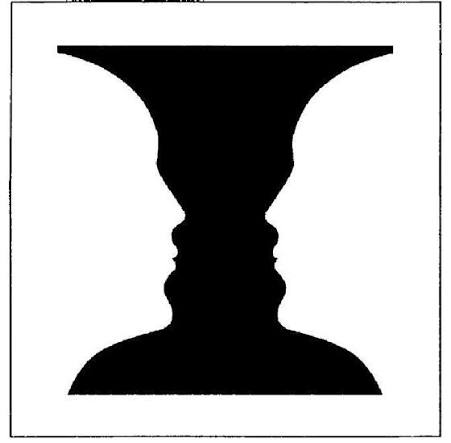
Embrace your music’s figure-ground: consciously moving one’s attention from one element of the music to another is a fascinating perceptual exercise, maybe even an education. Hear that beat? How exactly do each of its elements sound? Is the kick attack hard or soft? Is the cymbal tinny rather than crisp? Hear that pad? Is its stereo width where you want it? And is it the sound that’s wide or its reverb? Hear that reverb? Are the dimensions of its space how you want them? Hear that mix? What’s giving it its impact? Why does it still sound cloudy? Attending to the sound of a kick, pad, reverb, or mix is an example of what William James called taking possession of one of several possible perceptual objects, a momentary focusing of attention on one thing to try to experience it as it is.
But of course, how one sound sounds is shaped by the other sounds around it. This is why a bass sounds so different with and without a drum part with which it usually dances (and has frequency-clashing arguments). Fine-tuning a part while it’s soloed has its uses, but in general, hearing a sound in its context is the best way to hear how it functions.
Which brings us back to the idea of making a thousand small adjustments at once. If you were to observe a reasonably competent producer in the midst of working, you’d notice constant zig-zagging all over the track in progress. For me, this flurry of activity is guided by an intuitive sense that everything is, well, slightly wrong. Bring this up, bring that down. EQ that out, boost this. Open the filter, but not too much. Layer the reverbs, but keep them like tints, not sounds. Record the part and use it as is, then go on to the next. Change the panning, but only towards the end. Make that entrance align with the end of this. Randomize some of the hits, but only enough to sound natural. Sample the sample to make a new bit to fill the holes. But keep the holes; mute and mute and mute to add space. It can sometimes feel like making a thousand adjustments is futile, but it’s not. The reason is that each adjustment is an acknowledgement of the surprising amount of detail you’re noticing. Fine-tuning music takes as long as it takes to suddenly notice that now all of the sounds feel like they’re vibrating as one.


Leave a Reply