
“The problem of time is like the darkness of the sky. Every event is inscribed in its own time. Events may cluster and their times overlap, but the time in common between events does not extend as law beyond the clustering” (13).
“Most workers in the world carry the same physical stigma: a sign of how the labour power of their bodies has been wrenched away from their heads, where their thoughts and imaginings continue, but deprived now of the possession of their own days and working energy” (21).
“Paintings are static. The uniqueness of the experience of looking at a painting repeatedly—over a period of days or years—is that, in the midst of flux, the image remains changeless. Of course the significance of the image may change, as a result of either historical or personal events, but what is depicted is unchanging: the same milk flowing from the same jug, the waves on the sea with exactly the same formations unbroken, the smile and the face which have not altered. One might be tempted to say that paintings preserve a moment. Yet on reflection this is obviously untrue. For the moment of a painting, unlike a moment photographed, never existed as such. And so a painting cannot be said to preserve it. In early Renaissance art, in paintings from non-European cultures, in certain modern works, the image implies a passage of time. Looking at it, the spectator sees Before, During, and After. The Chinese sage takes a walk from one tree to another, the carriage runs over the child, the nude descends the staircase. Yet the ensuing images are still static whilst referring to the dynamic world beyond their edges, and this poses the problem of what is the meaning of that strange contrast between static and dynamic. Strange because it is both so flagrant and so taken for granted” (29).
“A musical composition, since it uses time, is obliged to have a beginning and an end. A painting only has a beginning and an end insofar as it is a physical object: within its imagery there is neither beginning nor end. This is what makes possible pictorial composition, harmony, form” (32).
“What the past, the present, and the future share is a substratum, a ground of timelessness” (32).
“There is a phenomenological problem at the start. One is obliged to begin with conscious experience” (39).
“But time appears to pass at different rates because our experience of its passing involves not a single but two dynamic processes which are opposed to each other: as accumulation and dissipation” (40).
“The deeper the experience of a moment, the greater the accumulation of experience. This is why the moment is lived as longer. The dissipation of the time-flow is checked. The lived durée is not a question of length but of depth or density. Proust understood this” (40).
“Cyclic views of time are based on a model whereby two forces are in play: a force (time) moving in one direction, and a force resisting that movement” (40).
“A voice belongs first to a body, then to a language. The language may change but the voice stays the same. I recognize your voice before I know in what language you are speaking” (56).
“The artist’s creative act was for him only one among many such acts. He [van Gogh] believed that reality could best be approached through work, precisely because reality itself was a form of production” (78).
“all the gestures with which he handled and manufactured the stuff of the painted image, are analogous to the activity of the existence of what he is painting. [van Gogh’s] paintings imitate the active existence—the labour of being—of what they depict” (78).
“And his compulsion? It was to bring the two acts of production—that of the canvas and that of the reality depicted—ever closer and closer. This compulsion derived not from an idea about art—this is why it never occurred to him to profit from reality—but from an overwhelming feeling of empathy” (80).
“It was there too that I discovered that I wanted as little as possible to do in this world with those who wield power. This has turned out to be a lifelong aversion” (84).
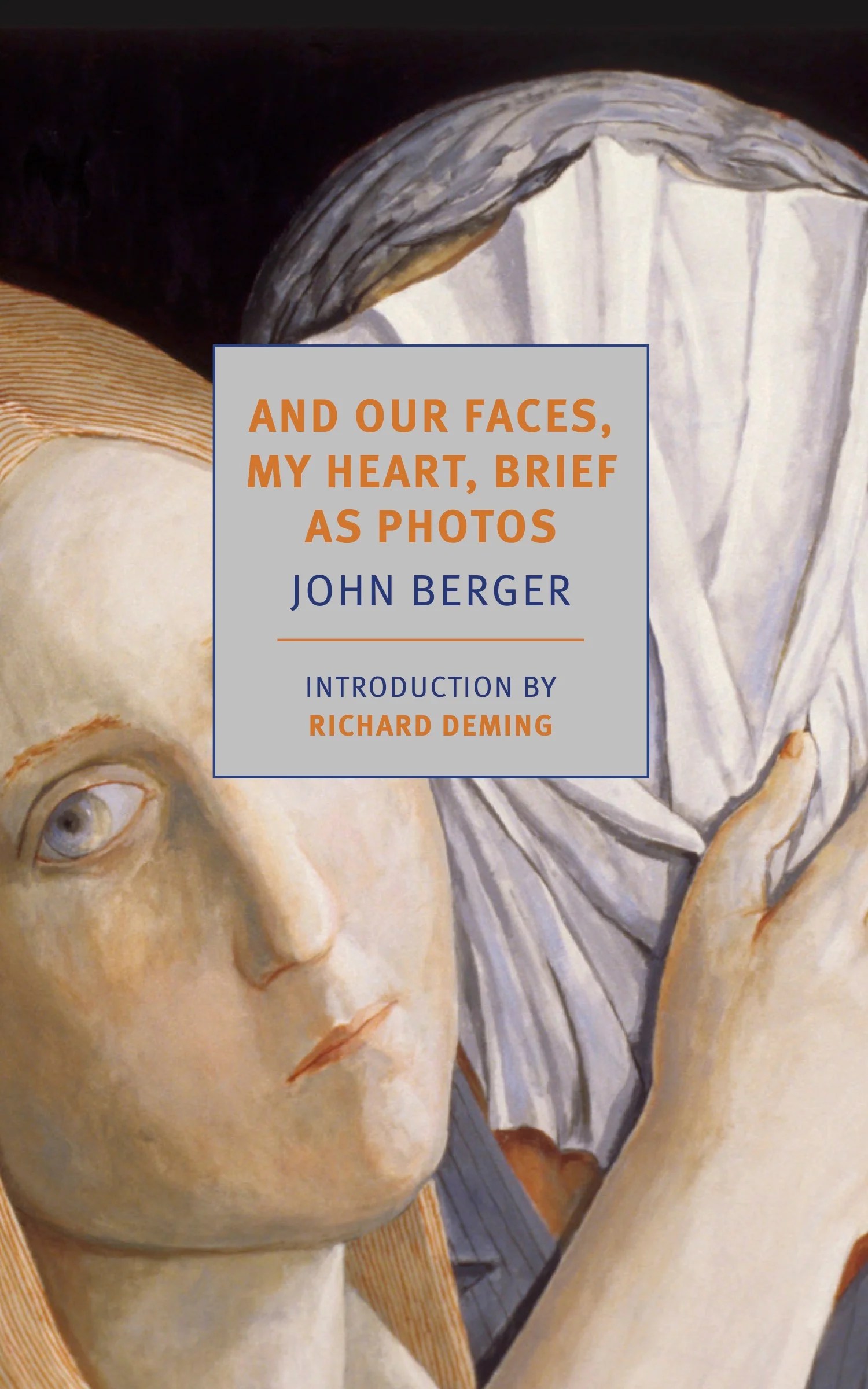
John Berger, And Our Faces, My Heart, Brief as Photos (2026)


Leave a Reply