
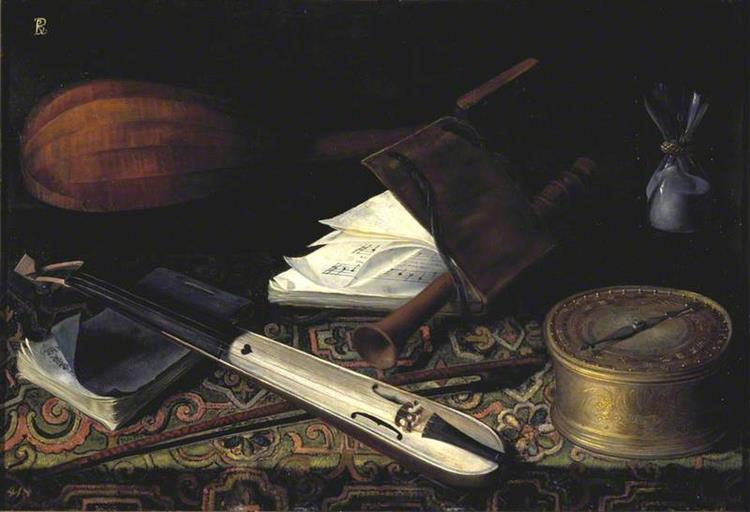
Pieter Gerritsz. van Roestraten,
Still Life with Musical Instruments (c. 1650)
A question pops up when I make music: What are my materials? It often feels like I’m lacking the sonic stuff that others surely have. Questions about materials multiply: What sounds am I using? Where are these sounds from? Are these the right sounds? Do I even like these sounds?
Sounds need to do something substantial as well as an appropriate context in which to do it. This is what makes instruments’ preset sounds unfinished. If I scroll through presets on an instrument, most of the patches I can’t make sense of. The patches may be full of vim and intrigue, but they don’t suggest a world that I want to be in. I hear the patch’s sound, but it’s as yet without a part that would give it a reason to exist. The sound may crudely or obviously suggest “ambient”, “trap”, or “trance”, but such broad and generic style markers are still miles from actual music.
Of course, one can easily generate materials by sampling sounds that have personal meaning. Every smartphone is a sampler: capture some rattling of keys on the kitchen counter, walking through the subway turnstile, or playing marimba rolls and you have a bespoke sonic palette. But while it’s widely believed that making one’s own sounds from scratch through sampling or synthesis is the surest way to sound like no one else, that’s not the case. Sounds and soundscapes are everywhere and there are millions inside even the most rudimentary music software.
One’s materials come to life in proportion to the relationship you develop with them over the course of making music. This is what makes composition different from making an espresso. With an espresso, the quality and freshness of the beans shape the flavor you’re able to extract from the coffee. But quality isn’t inherent in a music producer’s materials. Quality is a by-product of an approach, a point of hearing, a way of doing, a process. In the right context, any sound can be fascinating. A french horn tone positioned in the distance is longing; static used as a percussion part is beguiling. Enchantment is everywhere around us. Sometimes all that’s needed is a small tweak to a sound you already have. As producer A.G. Cook explains, any sound is potentially “five seconds away from opening up something that will create the total opposite.”
A part of composing that requires patience is letting one’s relationship with sounds unfold at the pace it wants. For long stretches of time I seem to be doing nothing more than trying things that don’t work, hearing things that sound blah, and having little confidence the situation will resolve itself. For the moment, the relationship isn’t happening because it’s me, not the materials, that’s stubborn. The obvious gambits aren’t working, the go-to techniques aren’t leading anywhere interesting. Clearly, figuring out the potentials of these materials is going to take a while.
One lesson from such interactions is that it takes time to figure out which aspect, fragment, or quality of the sounds will unlock something. This is illustrated when I comb through my own work, listening for samples. The good parts of this second encounter with the music are never where I expect them. The good parts tend to be almost hidden, appearing at the ends of phrases, during pauses, or in the reverb tails. Why? Because they loop oddly and produce a kind of satisfying repeating ambiguity. My theory is that the best musical fragments maintain tension, stay unresolved, and hold our attention because it’s not obvious where they’re going.
But am I looking for one part, or several parts? Sometimes it’s the combination of two or three parts that unlocks a composite rhythm, and the only way to figure this out is to try out various part permutations. I’ve begun with one part on the left and then added another on the right, then realized that a third part in the middle is what makes everything gel. Or maybe what’s needed is for different parts to move at different speeds and in different octaves. Or for the middle part to be low-pass filtered, while the left and right parts are high-passed, so everything is more stratified, frequency-wise. Our relationship with sounds is ultimately about discovering something meaningful that we can do with them.
Let’s return to the questions at the opening of this essay: What sounds am I using? Where are these sounds from? Are these the right sounds? Do I even like these sounds? Once you find a relationship with your materials, their specifics don’t matter so much. Now that you’re in the flow of things, finding the good bits, trying out different pattern combinations, and bending everything into coherence, you realize that what matters is the way of thinking about structure and an ear for feeling that you bring to this musical encounter. Even if this is just a sketch, finding ways of relating to your materials has given you a chance to make something good.


Leave a Reply