
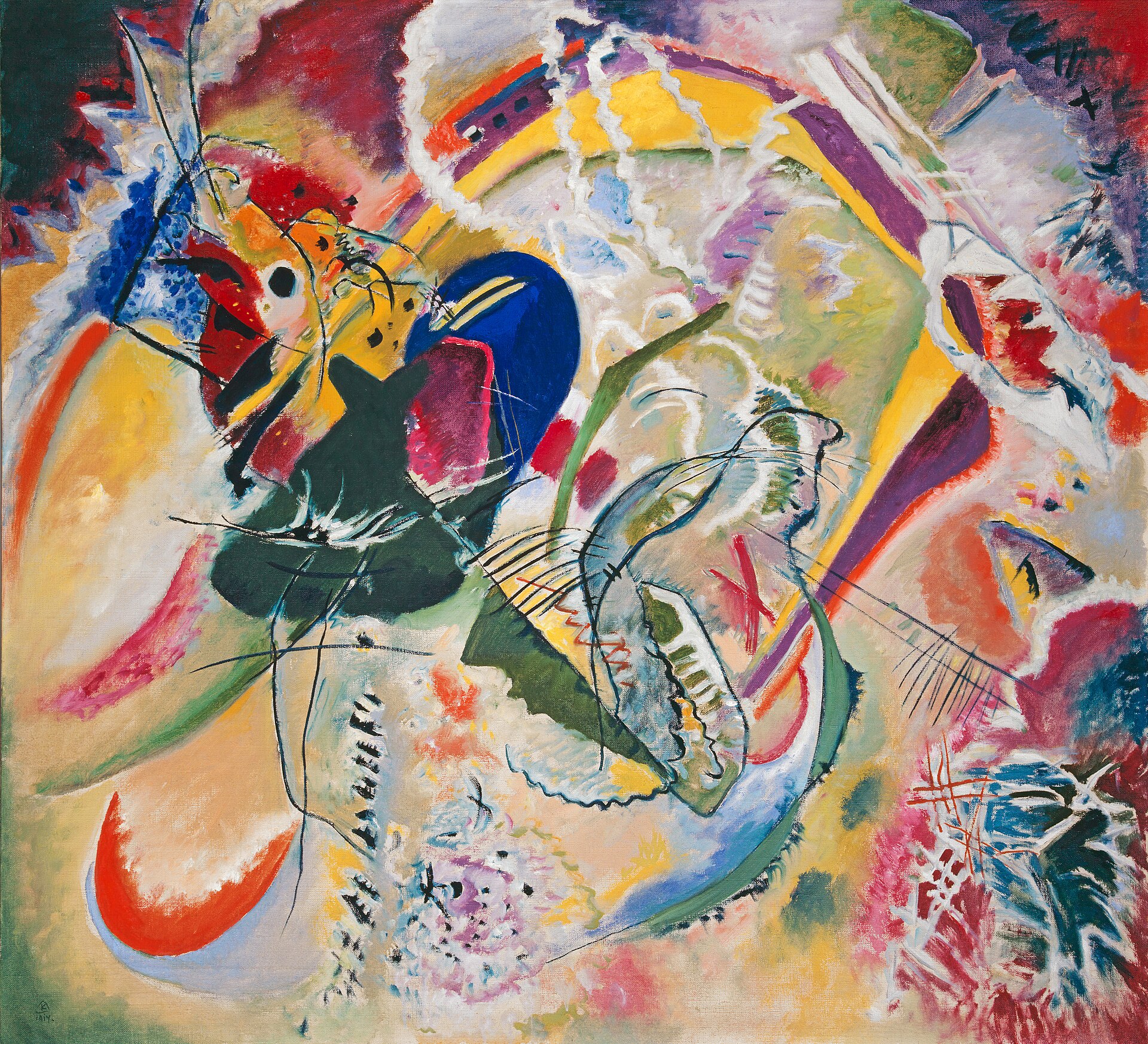
Wasily Kandinsky, Improvisation 35 (1914)
Music production is a back-and-forth between two ways of organizing sound. The first way is intuitive, which means making by playing, improvising, trial and error, and following whatever sounds good. The intuitive is an example of what Daniel Kahneman called System 1 thinking, which is decision-making that’s fast and instinctive. A typical scenario is playing around with a sound you like, hearing what it can do and what you could do with it, listening for a potential part, and recording something. In theory and often in practice, if you can make a part you can make a piece based upon this part.
The second way of music production involves techniques for building upon what you intuited. Production technique is System 2 thinking, which is decision-making that’s slow and deliberate. A typical scenario is that once you have a part, it needs to be developed, framed, orchestrated and arranged, processed, edited, and so on. Techniques for building upon a part are many, especially so in software where sound manipulation is boundless. But slow down and you’ll notice that some paths are more reliably fruitful than others. Accomplished musicians tend to rely on a few techniques, because they accomplish more—for example, resampling and processing, or using audio as a source of new MIDI.
I find it helpful to keep in mind a workflow that seldom works: a technique shouldn’t be the originating source of an idea, only its elaborating tool. For example, one doesn’t begin with a filter sweep, a counterpoint device, or granular sampling and then go looking for material to run through these creative machines. You could begin with a technique, but that would bypass the enchantment of one’s experience and expertise. Instead, begin with an idea that exists independently of what might be done with it. Even in the most synthetic musics, an idea is melodic, harmonic, rhythmic, or timbral, and it needs time to unfold. No matter how far out a music seems to be, it always contains traces of these fundamentals.
Once you have an idea—e.g. a few chords or a beat—the question now is how this oscillation between the intuitive and the technical will play out in your workflow. It depends—on the idea, and on you! Sometimes it makes sense to record every part live, and sometimes a single part is enough to generate everything else. For some tracks, a part may need layered processing to come alive, with each effect pulling the sound in a different direction. With this approach, beginning with the simplest gesture sets the stage for nuanced elaborations upon it. I’ve made interesting beats this way. I’ll play a predictable rhythm (intuition) and then figure out ways to mess with its component sounds, applying different effects to the kick, snare, and hi-hat sounds (technique). I trust trial-and-error will lead me somewhere more interesting than where I began, and I’ll persist with trying out bespoke processing chains until the beat is unrecognizable and, most importantly, something I’d enjoy listening to and building upon.
In sum, there’s not only a back-and-forth between the intuitive and the technical (or System 1 and System 2 thinking); their ratios change all the time. Sometimes you’re playing parts, and sometimes you’re adjusting them. Lest you get discouraged when one or the other approach isn’t bearing fruit, keep changing it up and remember: playing an instrument and tinkering with its black box parameters are both ways of making music.


Leave a Reply