
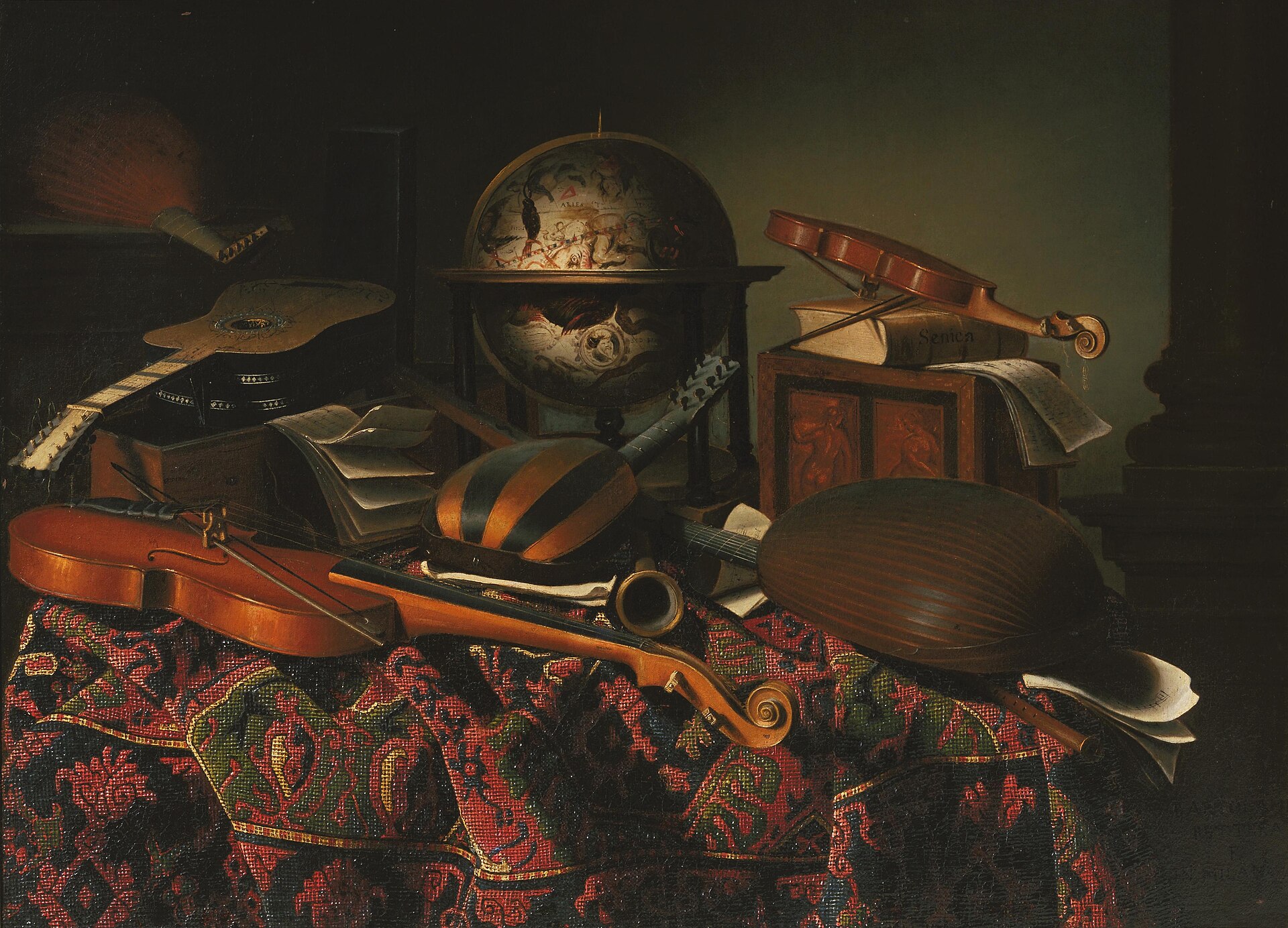
Bartolomeo Bettera, Still Life with Musical Instruments (c. 1687-1699)
When you’re composing music you’re following your ear, but what’s your ear following? For one thing, all of your experience, which provides a tacit knowledge framework for knowing what has worked and therefore what might work. There are also general categories, or types, of sounds and sound sensations one can keep in mind while constructing music; in fact, you may already be using them without realizing it. Let’s take a look.
Lows, Mids, Highs
Notice a trio of sounds hitting at the same time: a ride cymbal and kick drum, a mid-range piano chord, and a deep acoustic bass note. This is a classic jazz trio sound, but it’s also three zones of the frequency spectrum: lows (bass and kick), mids (piano), and highs (cymbal). Lows-Mids-Highs is perhaps the ultimate general compositional template, in that if you have parts living in each of these frequency registers, you set the stage for a rich orchestration.
Opaque, Gossamer
Some sounds feel opaque, as if nothing can penetrate them, while others let light through. Opaque sounds tend to be those with lows, mids, and highs sounding all at once, hogging the frequency spectrum without leaving space for other sounds. (This is why synthesizer patches loaded with effects rarely work in a track.) Gossamer sounds tend to leave space for other sounds to be heard through them. An otherwise opaque pad sound, for example, can have its lows or its highs filtered out (using a high-pass or low-pass filter, respectively) so that while it sounds the same, it occupies a narrower band of the music’s spectrum. This clarifies the mix, and the frequencies untouched by the filtered sound can now be inhabited by other parts.
Warm, Cold
There are numerous ways to achieve sounds that are warm or cold, and, of course, our perception of a sound having a temperature is both subjective and metaphorical. Sounds perceived as warm often have soft (gradual) attacks and long sustains, so that they neither surprise you (you hear them coming) nor suddenly abandon you (you hear them going away). A warm sound may also have a rolled-off top end, a muted or pure timbre (e.g., a sine wave, not a sawtooth wave), subtle distortion (e.g., tape saturation), and a reverberant context. Sounds perceived as cold tend to have sharp (quick) attacks and short sustains that startle, brighter textures (e.g., a saw wave, not a sine), and a dry context. When warm and cold sounds are combined our perception of them is intensified and takes on a spatial quality. For instance, a reverberant voice set against dry chords, or vice versa, changes the perceived front-back location of those sounds in the mix.
Static, Evolving
A static sound doesn’t change its pattern, its timbre, or its rhythm over the course of a loop or a phrase. An evolving sound, on the other hand, changes itself in one or multiple ways over time. A classic static sound is a drone or continuous sustained tone, while a classic evolving sound is a slowly opening or closing filter. But as with mixing warm and cold sounds, why not combine ideas by filtering the drone? What was static becomes evolving as the filter foregrounds (or obscures) different harmonics previously hidden in the sound.
Rhythmic, Tonal-Textural
Almost any sound can play a rhythmic or tonal-textural role, but not all sounds in a track need to be both. Percussion sounds are usually rhythmic, articulating a beat, while chords or field recordings play a tonal-textural role. Taking a moment to ask whether your next sound should add rhythm or a tonal texture element will clarify your compositional decision-making, and may even propose exceptions. For example, a percussion part can operate more tonally than rhythmically, while a chord part can be highly rhythmic (e.g., an arpeggio) and just barely textural. Also, some effects, like sidechain compression and tremolo, can be used to rhythmify an otherwise non-rhythmic part.
Angular, Rounded
Generally speaking, music’s beat and rhythm components are felt as punchy and angular because percussion sounds have hard attacks and quick decays, making them subjectively pointy-shaped—their transients literally cut through a mix. Keys, pads, leads, voices, and atmospheres, on the other hand, tend to feel rounded. This subjective difference between the perceived angular versus rounded feel of sounds recalls the “bouba/kiki” sound-symbolism experiment in psychology that demonstrated our associations between certain speech sounds and certain shapes. But in music, sounds aren’t necessarily locked into their traditional roles. Percussion parts can be mellow (think gongs), while strings can be aggressive. Combining different sound shapes, such as a piercing bell over an oceanic ambience, gives the music a tactile contrast.
Kinetic, Suspended
No matter what your sound palette, think about the kind of feel or energy you hope your music will have. (Conversely, listen to the music you have already made to deduce your favorite feels.) Feel is, to some degree, independent of the music’s style. For me, two broad categories of feel are kinetic and suspended, both of which can be achieved rhythmically, tonally, and texturally. Kinetic is a certain kind of forward-moving vitality, while suspended leans toward a meditative, still quality. Kinetic is trying to get somewhere, while suspended is just being. Kinetic is running, suspended is sitting. You get the idea. Remember that any sound can have either feel because it’s what you do with a sound, through your physical or virtual touch, that shapes its effects.


Leave a Reply