
“the beginning of the slow replacement of reality by screen time (65).
“The screen tends towards chaos” (71).
“The aim of much ‘content’ is not to educate viewers or to inform them. It is not even really to amuse them. The highest aspiration of many of the most successful masters of the medium is simply to retain eyeballs. Whether the audience is enjoying what they are experiencing is a secondary and one senses even antique consideration” (75).
“Short video is the nightmare logical conclusion of the fragmentary and chaotic picture of reality that Neil Postman identified as characteristic of television” (77).
“These surreal entertainments succeed because they push a series of human buttons very hard and very fast. In seconds they supply sex, comedy, emotional drama and visual novelty. This is entertainment that has been blitzed by the food-blender forces of the algorithm to its most easily digestible form. There is a reason these are the kinds of content colloquially known as ‘slop’. Any fibrous informational matter – nuance or complexity or context – has been mashed down into pap” (78).
“We are rapidly discovering that ‘more informed’ does not mean ‘better informed’. The fragmented nature of the information presented by the screen renders much of it almost useless” (79).
“For a lot of people, reality is an increasingly marginal phenomenon that occurs around the edges of screen time” (80).
“The virtual world has flooded the actual world, swamping the last remaining islands of untouched reality. Everywhere – at the park, on the bus, climbing a mountain – the seductive mirrored door out of real life hovers, always waiting for us and requiring only the touch of a finger to push it open” (80).
“If the world feels dumber it is not because people are literally becoming less intelligent. It is rather because smartphones are making our culture simpler and more trivial. It is almost impossible to support subtlety or complexity in a world of shattered attention and near constant distraction. If the rise of reading in the eighteenth century was accompanied by an explosion of sophisticated and innovative kinds of thinking, in the twenty-first century, complexity and difficulty are being systematically routed out from every corner of our society. We are undergoing what might be termed a Great Simplification” (90).
“Distracted and unfocused, our culture risks being transformed into a smartphone wasteland. We seem fated to endlessly repeat and pastiche ourselves, superhero film by superhero film, repetitive pop song by repetitive pop song” (94).
“It may be that we are facing an unenlightened future that looks like our unenlightened past – one in which power, wealth and knowledge concentrate at the top of society, and an angry, divided and uninformed public lacks the means to understand, analyse, criticise or change what is going on” (152).
“Books offer us our best chance of grappling with the world as a comprehensible whole, not as a whirling snowstorm of fragments. If you want to get a handle on the sweep of history or a scientific theorem or a complex philosophical argument, you have no option but to turn to a book” (161).
“Franz Kafka said, ‘One reads in order to ask questions’” (162).
“The fashionable idea that all entertainment is created equal is incapable of dealing with an age of addictive screen technologies. If all culture is created equal and the only thing that matters is whether you are having a
good time, then why not spend every evening of your life scrolling on your phone?” (165).
“The twenty-first century’s much-documented epidemic of anxiety, depression and purposelessness is at least partly rooted in the pointlessness, fragmentation and triviality of the culture of the screen” (165).
“The smartphone offers an infinity of easily consumable ‘content’, but as a medium it is pathetically ill-equipped to speak to the deeper human need for curiosity, learning, narrative, close attention and artistic fulfilment” (166).
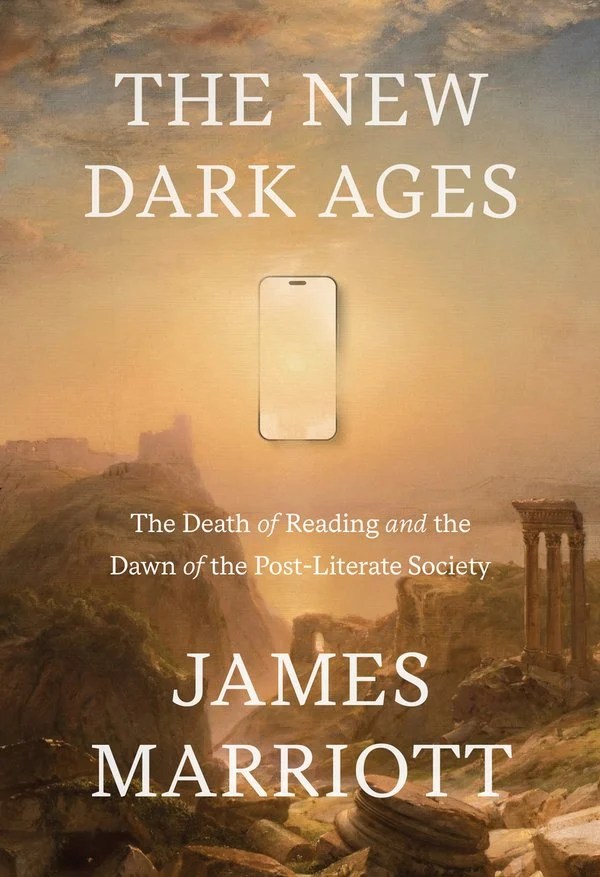
James Marriott, The New Dark Ages (2026)


Leave a Reply