
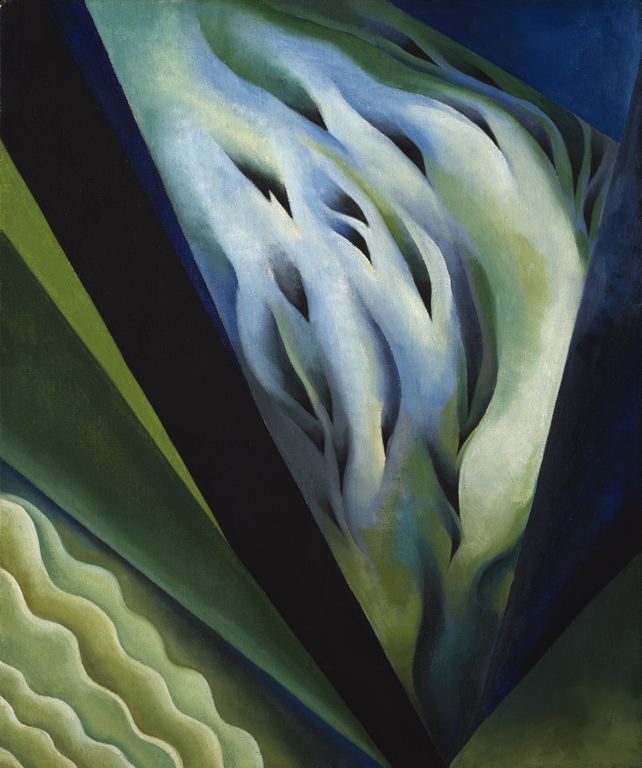
Georgia O’Keefe, Blue and Green Music (1919-1921)
“Music evokes a sense of sightlessness or loss — a loss for which it is both lament and compensation.”
Geoff Dyer, The Ongoing Moment (2005, p. 25)
Music always contains traces—of its composers and performers, of its time-place-culture origins, of the instruments used to make it, of its predecessors and influences, of the theoretical frameworks that structured it, of the interior worlds it conjures in listeners, of what it aimed for and missed, and of the possible future uses it may someday find. In other words, the trace is music’s implicit communication. It’s the source of music’s power and enchantment, the signifying space between its notes. Traces are all the things music embodies, telegraphs, and triggers while its sounds are busy.
Traces enter the composing process from the get-go, because one is always keeping an ear on anything that seems to say something beyond its sound, a pattern whose sum seems more than its parts, an aggregate of significance. As Errollyn Wallen notes in Becoming A Composer, “Intuition is an awareness of patterns, above and below the surface, seen and unseen, heard and unheard.” In making music, what appears significant to the maker is a moving, shape-shifting target. This is especially the case when one is beginning a track and what catches our attention is unpredictable and different every time. Consider some common scenarios:
• While flipping through sounds I notice an interesting one and build a piece around it. What happens is that I’m so enamored by the sound that I’ll play it continuously to hear what it can do, or to find the thing it’s ideally suited for.
• A drum rhythm is boring (predictable) until I warp it in some way and bend both its sound and its pattern. Surprising rhythms always seem to be saying something.
• Moving between two chord shapes stirs a memory. I keep returning to the chords, repeating them (for fear of forgetting them) and using them as a cadence.
• I layer an audio sample onto some chords I’ve already recorded. There’s no reason these two unrelated worlds should work together, but sometimes they do. How can this be? Each source carries its own traces which overlap to create a new, shared space.
• Having improvised something, I notice that the improvisation’s meandering structure and performance inconsistencies could scaffold a piece. In other words, I can build other parts upon traces of my having been lost while improvising. If you trust it, sometimes music theory is in your hands.
• An initial part has ample space around it because it isn’t yet surrounded by accompanying hangers-on. I notice that’s what not there is as important as what is, and the part is leaving space for listeners to perceive their own traces. Should this be a solo?


Leave a comment