
“farms of servers, clouds of data, AI ecosystems—the allusions are always to the natural world that the machinery is destroying” (5).
“Within the Artificial State, nearly every element of public and democratic life—civil society, representative government, an informed citizenry, equality of rights, freedom of thought, freedom of expression, and faith in elections—is vulnerable to subversion through the reduction of politics to the digital manipulation of attention-mining algorithms, the trussing of government by corporate-owned digital architecture, the diminishment of citizenship to minutely message-tested online engagement. The liberal nation-state requires the consent of the governed, the voice vote, quavering; the raised hand, sweating; the signature, wavering; the heart, pulsing” (5).
“The Artificial State is the factory farming of humans, the sorting and segmenting, the isolation and alienation, as if humans were becoming to machines what animals had become to humans” (10).
“In The Poverty of Philosophy (1847), Karl Marx argued that every social order is determined by its machinery: ‘The handmill gives you society with the feudal lord; the steam-mill, society with the industrial capitalist’” (28).
“If, in the history of epistemology, mystery had yielded to the fact which had in turn yielded to numbers and, finally, to data, the circle had begun to close, as data became, itself, mysterious, cloaked in the language of the sacred” (80).
“Yet there was, from the very beginning, even before the start of the internet era, a theological undercurrent running through Silicon Valley like a stream. After the emergence of generative artificial intelligence, that stream became a river. Companies like OpenAI and xAI, which did not make money but instead assured investors that they one day would, promised, messianically, that their tools would usher in a new era for humanity: ecstasy, salvation, even eternal life” (93).
“A goal of the engineers of artificial intelligence is to create machines with the capacity for speech and for reason, whether they have bodies or exist only in boxes. To imagine an artificially intelligent robot (and ignore all the other bits about being human), you have to convince yourself of a very particular notion of intelligence, one that rests on the principle that humans are not animals—or not merely animals—and that the mind has an existence separate from the body. Without the idea of the separation of the human from the animal and the mind from the body, it would not be possible to chat with a disembodied, computer-generated voice and mistake it for a human” (133).
“Bizarrely, almost impossibly, the parable of the Artificial State, a cautionary tale about the enslavement of humanity to machinery, eventually became a business plan. It made this leap in the early decades of the twenty-first century, when many of the merchant princes of Silicon Valley began to subscribe to a philosophy known as longtermism” (149).
“History looks to the past. Longtermism looks to the future. It understands the course of events in reference to a very long timescale, one that stretches forward millions or even tens of millions of years into the future, a future at once easy to imagine and even to begin to build, and yet forever some distance away. This commitment to the vanishingly faraway future worked to relieve the architects of the Artificial State of any obligations to the present” (150).
“Longtermism is an upside-down version of nineteenth-century natural history, with all the animals erased, robots put in their place, and time stretching back not to a past that requires explaining but toward an imagined future used to justify the accumulation of staggeringly large fortunes” (152).
“Long before advocates of longtermism reimagined the history of the world without nature in it—no plants, and no animals—and imagined a future in which humans are threatened with extinction by an artificially intelligent successor species, science fiction writers had begun to erase animals from their stories and to insert, in their stead, machines” (167).
“By the middle of the 2020s, vastly consequential decisions about the future of Earth and everyone and everything on it were being made by a handful of men based on their colossal accumulation of wealth, their catastrophic misreading of history, literature, and philosophy, and their breathtaking contempt for ordinary people, living and dead” (205).
“What did these corporations seek? They sought profit and power and resources. As to their stated objectives—giving power to the people, connecting people to one another, liberating people from labor—they never met them. They were less political revolutionaries than they were religious zealots; they were evangelists: saviors. They had not objectives but missions: ecstasy, redemption, salvation, eternal life. They would abandon the secular nation-state and Earth itself: they would open the very gates to the heavens” (222).
“The Artificial State in which a great many humans have begun to live has not promoted their safety and happiness; it is a prison whose walls are comprised of mirrors: glowing screens. In its cells there are no windows that open to the wider world, to sea and sky, forests and valleys, islands and cliffs. From inside, no sound can be heard, not the rustling of animals, not the snapping of branches, not the roar of waves” (226).
“Don’t tether yourself to a computer. Unplug. If you cut down all the trees and kill all the animals, you will die. Using robots to wage wars will always backfire: one day, they will wage war on you. If you discover an intelligent species of newts, don’t enslave them. It’s best not to build something you can only unbuild by inventing a time machine. Never build a wall between yourself and the natural world, but if someone else does, clamber over it” (228).
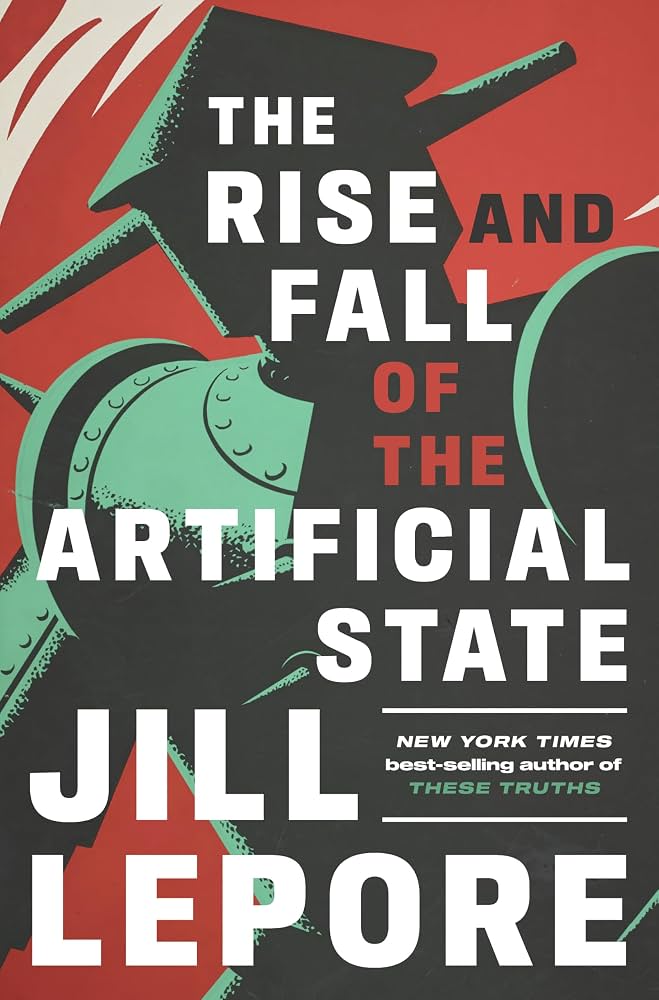
Jill Lepore, The Rise and Fall of the Artificial State (2026)


Leave a comment