
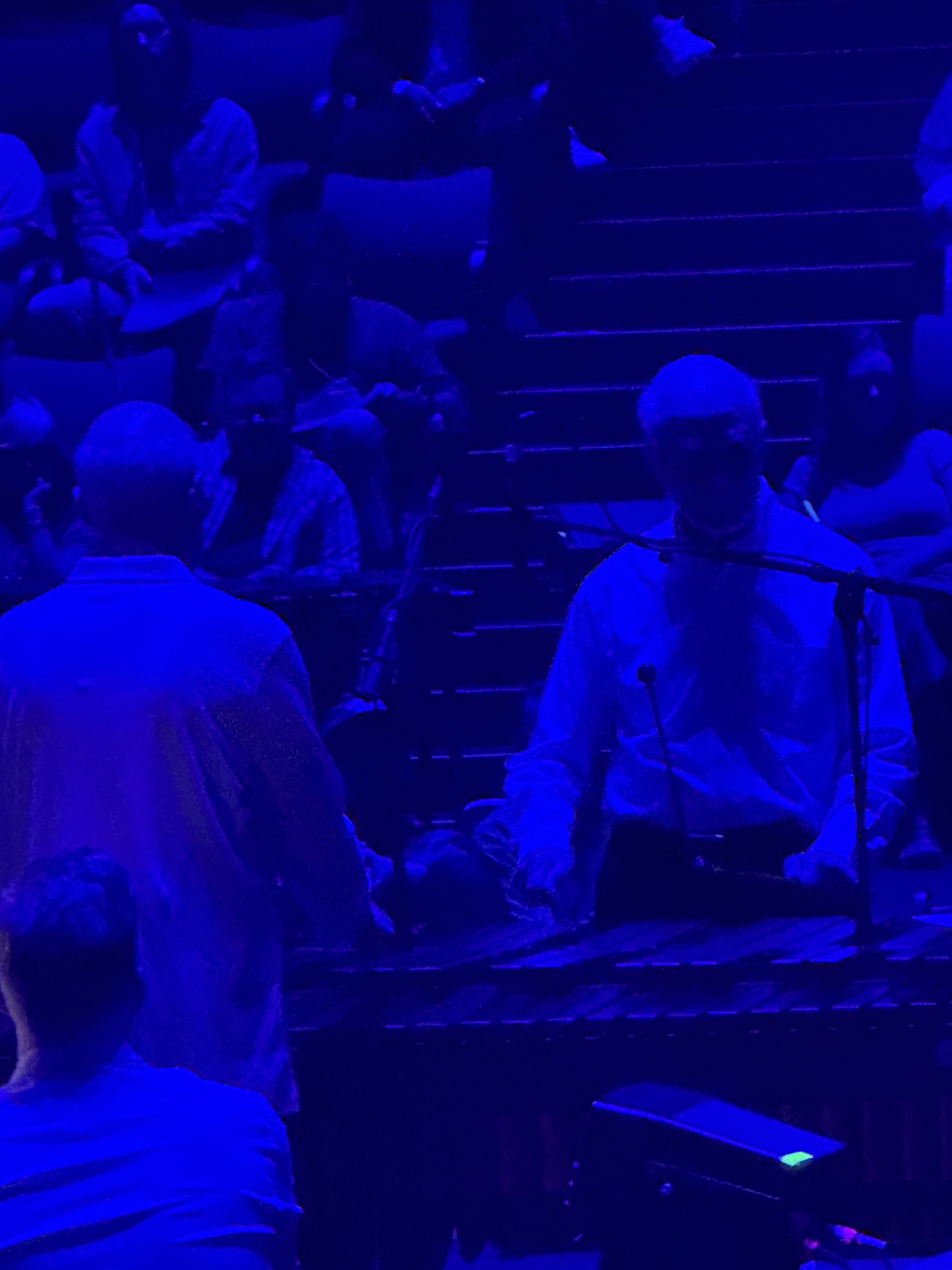
Percussionists Bob Becker (left) and Russell Hartenberger performing Music for 18 Musicians at Park Avenue Armory (2026)
I recently attended a dress rehearsal for composer Steve Reich’s Music for 18 Musicians (1976) at Park Avenue Armory. Many of the musicians who played on the 1978 recording of the piece were performing (including my teacher), which was a treat because their ways-of-the-hand knowledge is masterful; they make playing this intricate music look effortless. Here are four lessons from the 60-minute composition:
Give the music a pulsation through-line that goes on for a long time. Music for 18 is unified by a steady 16th-note pulsation or timeline played on marimbas and xylophones for the duration of the piece. While the parts for winds, strings, voices, and pianos are essentially short repeating modular phrases, the percussion pulsation holds everything together. But more than that, the timeline becomes magical the longer it pulsates. Like the bell part in a West African drumming ensemble or the jazz drummer’s ride cymbal, a timeline needs time to unfold.
Make the music a process. Parts in Music for 18 come and go, but they do so in an organized, processual way. They build themselves up one note at a time, so you can hear how they’re “thinking” as they’re repeating. (Reich initially developed this building-up process as a distillation of his canonic phasing technique that was inspired by two tape machines going out of sync.) Parts also fade in and out like an acoustic rendering of what a DJ might do with a mix.
Build into the music opportunities for tension-making. Even with its steady marimba and xylophone timeline, Music for 18 is always teetering. You can hear micro-fluctuations in tempo, in synchrony, in accents, in tone and tuning, in breath (the singers have a particularly demanding role), and even in the odd missed note that jolts you—oh, wait, that’s not in the pattern! In other words, although one could probably sequence Music for 18 to render it perfectly, it comes to life through performance imperfections that arise as a spectral layer of meaning. As I listened I could sense the musicians sensing one another at every moment, always adjusting and staying locked in, forever unquantized. When we’re making music we’re always teetering on the edge of Now, on the verge of the next moment, and that’s where tension becomes emotional.
Build into the music a structure that values cooperation. It’s hard to take in Music for 18 and not be impressed by the level of cooperation it models. The musicians share marimbas, sit side by side on piano benches, and everyone becomes a percussionist because every part is percussive. Importantly, there’s no conductor so the ensemble relies on close listening and muscle memory to play memorized parts that require an endurance sport level of technique and shared concentration, or what the social phenomenologist Alfred Schutz once called a mutual tuning-in. As I took in the music I thought about how it proposes a kind of ideal society in which instead of arguing and disagreeing all the time, we might listen closely to one another to collaborate to make something bigger than the sum of our parts. Ideally, composing designs a context in which musicians and listeners tune themselves through sound and create a (peaceful and groovy) shared world that lasts for a while.


Leave a Reply